 Catalogue PIGMA
A broad-scale long-term dataset of Sabellaria spinulosa distribution and abundance
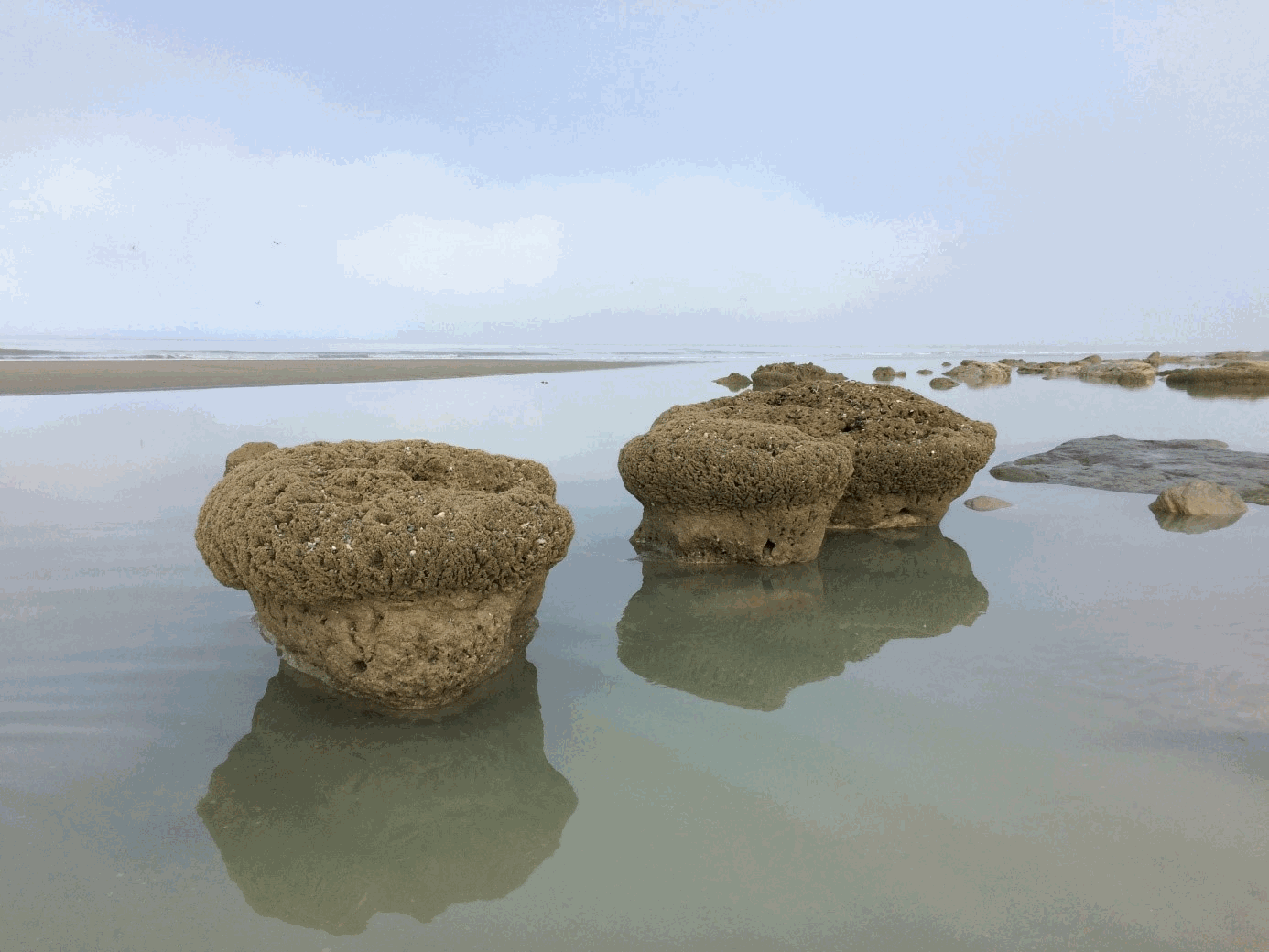
Numerous reef-forming species have declined dramatically over the last century. Many of these declines have been insufficiently documented due to anecdotal or hard-to-access information. The Ross worm Sabellaria spinulosa (L.) is a tube-building polychaete that can form large mostly subtidal reefs, providing important ecosystem services such as coastal protection and habitat provision. It ranges from Scotland to Morocco and into the Mediterranean as far as the Adriatic, yet little is known about its distribution outside of the North & Wadden Seas, where it is protected under the OSPAR & HELCOM regional sea conventions respectively. As a result, online marine biodiversity information systems currently contain haphazardly distributed records of S. spinulosa.
One of the objectives of the REEHAB project (http://www.honeycombworms.org) was to combine historical records with contemporary data to document changes in the distribution and abundance of the two Sabellaria species found in Europe, S. alveolata and S. spinulosa. Here we publish the result of the curation of 555 S. spinulosa sources, gathered from literature, targeted surveys, local conservation reports, museum specimens, personal communications by authors their research teams, national biodiversity information systems (i.e. the UK National Biodiversity Network (NBN), www.nbn.org.uk) and validated citizen science observations (i.e. https://www.inaturalist.org ). 56% of these records were not previously referenced in any online information system. Additionally, historic samples from Gustave Gilson were scanned for S. spinulosa information and manually entered.
The original taxonomic identification of the 40,261 S. spinulosa records has been kept. Some identification errors may however be present, particularly in the English Channel and Mediterranean where intertidal and shallow subtidal records can be mistaken for Sabellaria alveolata. A further 229 observations (16 sources) are recorded as ‘Sabellaria spp.’ as the available information did not provide an identification down to species level. Many sources reported abundances based on the semi-quantitative SACFOR scale whilst others simply noted its presence, and others still verified both its absence and presence. The result is a curated and comprehensive dataset spanning over two centuries on the past and present global distribution and abundance of S. spinulosa.
Sabellaria spinulosa records projected onto a 50km grid. When SACFOR scale abundance scores were given to occurrence records, the highest abundance value per grid cell was retained.
Simple
- Date (Publication)
- 2024-09-27
- Date (Revision)
- 2026-05-29
- Other citation details
- Cordier Céline, Firth Louise B., Dubois Stanislas, Board Callum, Bocher Enora, Cox Caitlin, Cox Rebecca, Ducker James, Gruet Yves, Kerckhof Francis, Lovatt Chloe, Segeat Benjamin, Curd Amelia (2024). A broad-scale long-term dataset of Sabellaria spinulosa distribution and abundance. SEANOE. https://doi.org/10.17882/102259
- Credit
- The authors wish to thank Yves Samyn, curator of the Recent Invertebrates (non-insects) Collection of the Royal Belgian Institute of Natural Sciences, who made the data of the Gilson collection available to us. Morgane Le Gall from the Bibliothèque La Perouse is thanked for her help in tracking down historical records. This dataset has benefited from the participation of dozens of volunteers in citizen science projects (i.e. The Shore Thing, iNaturalist, the REEHAB project) and environmental NGOs (i.e. Bretagne Vivante, Estran22). Their contribution is gratefully acknowledged.
- Theme
-
- biogeography
- temperate reef
- Sabellaria spinulosa
- ross worm
- distribution
- OSPAR
- Biological oceanography
- Use constraints
- Other restrictions
- Other constraints
- Data are published without any warranty, express or implied. The user assumes all risk arising from his/her use of data. Data are intended to be research-quality and include estimates of data quality and accuracy, but it is possible that these estimates or the data themselves contain errors. It is the sole responsibility of the user to assess if the data are appropriate for his/her use, and to interpret the data, data quality, and data accuracy accordingly. The authors welcome users to ask questions and report problems.
- Date (Publication)
- 2026
- Unique resource identifier
- 10.1016/j.seares.2026.102693
- Association Type
- Cross reference
- Initiative Type
- Study
- Metadata language
- English
- Topic category
-
- Oceans
))
- Begin date
- 1778
- End date
- 2023
- Distribution format
-
-
CSV
(
)
-
PDF
(
)
-
CSV
(
)
- OnLine resource
-
Quality controlled data
(
WWW:DOWNLOAD-1.0-link--download
)
dataset - 16 MB
- OnLine resource
-
metadata - 416 KB
(
WWW:DOWNLOAD-1.0-link--download
)
metadata - 416 KB
- OnLine resource
- DOI of the product ( WWW:LINK-1.0-http--metadata-URL )
- OnLine resource
- Seanoe ( rel-canonical )
- Hierarchy level
- Dataset
- File identifier
- seanoe:102259 XML
- Metadata language
- English
- Character set
- UTF8
- Hierarchy level
- Dataset
- Date stamp
- 2026-05-29
- Metadata standard name
- ISO 19115:2003/19139
- Metadata standard version
- 1.0
Overviews
Spatial extent
Provided by
