 Catalogue PIGMA
20 cm
Type of resources
Available actions
Topics
Keywords
Contact for the resource
Provided by
Years
Formats
Representation types
Update frequencies
status
Resolution
-

Digital Surface Models (DSMs) of the study area were generated by drones on 19 September 2024 and 18 September 2025. Each pixel represents the elevation value of the terrain at the time of the survey. These DSMs were generated from 895 (2024) and 1,282 images (2025), captured at an altitude of 120 (2024) and 100 meters (2025) using the DJI Mavic 3E RTK and Mavic 3M RTK drones, with ground resolutions of 3.19 (2024) and 2.63 cm/pixel (2025). The surveyed area covers approximately 1 km². The DSMs were resampled to a resolution of 20 cm. The vertical coordinate system used is NGF IGN69.
-

The multispectral images of the study area were acquired by drone on 18 September 2025 using the DJI Mavic 3M RTK. The orthomosaic was generated from 5,128 images across five spectral bands (Green, Red, Red Edge, Near-Infrared (NIR), and Alpha), captured at an altitude of 100 meters (2025). The ground resolution achieved was 4.568 cm/pixel, covering a surveyed area of approximately 0.94 km². The Digital Surface Models (DSMs) were resampled to a resolution of 10 cm.
-
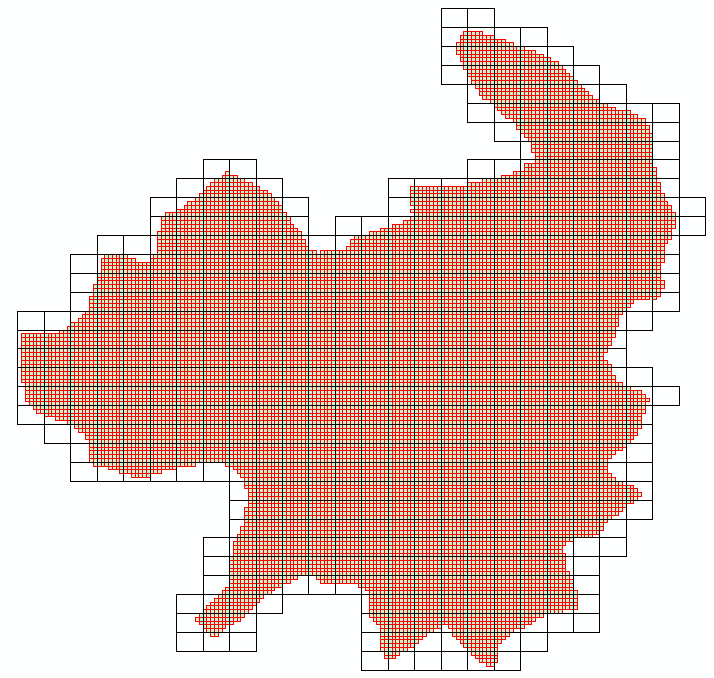
Pour faciliter la diffusion et l'utilisation de la maquette 3D, le territoire de Bordeaux Métropole a été découpé en tuiles qui correspondent à un redécoupagede 1,4 km x 1 km du maillage initial (TO_DALLE) qui s'applique aux Orthophotos et au MNT sur le territoire de la Métropole
-
Maquette 3D au rendu réaliste du territoire de Bordeaux Métropole à l'été 2012. Cette modélisation est issue de l'assemblage du Modèle Numérique de Terrain (MNT) drapé de l'orthophoto été 2012 et des modèles 3D de bâtiments en niveau de détail LOD2 (norme cityGML) et texturés à partir de photos aériennes.
-
Maquette 3D blanche du territoire de Bordeaux Métropole à l'été 2012. Cette modélisation est issue de l'assemblage du Modèle Numérique de Terrain drapé d'un fond de plan et des modèles 3D de bâtiments en niveau de détail LOD2 (norme cityGML). Les modèles 3D ne sont pas texturés, d'où le nom de « maquette blanche ».