 Catalogue PIGMA
Altran
Type of resources
Available actions
Topics
Keywords
Contact for the resource
Provided by
Years
Formats
Representation types
Update frequencies
status
Scale
-
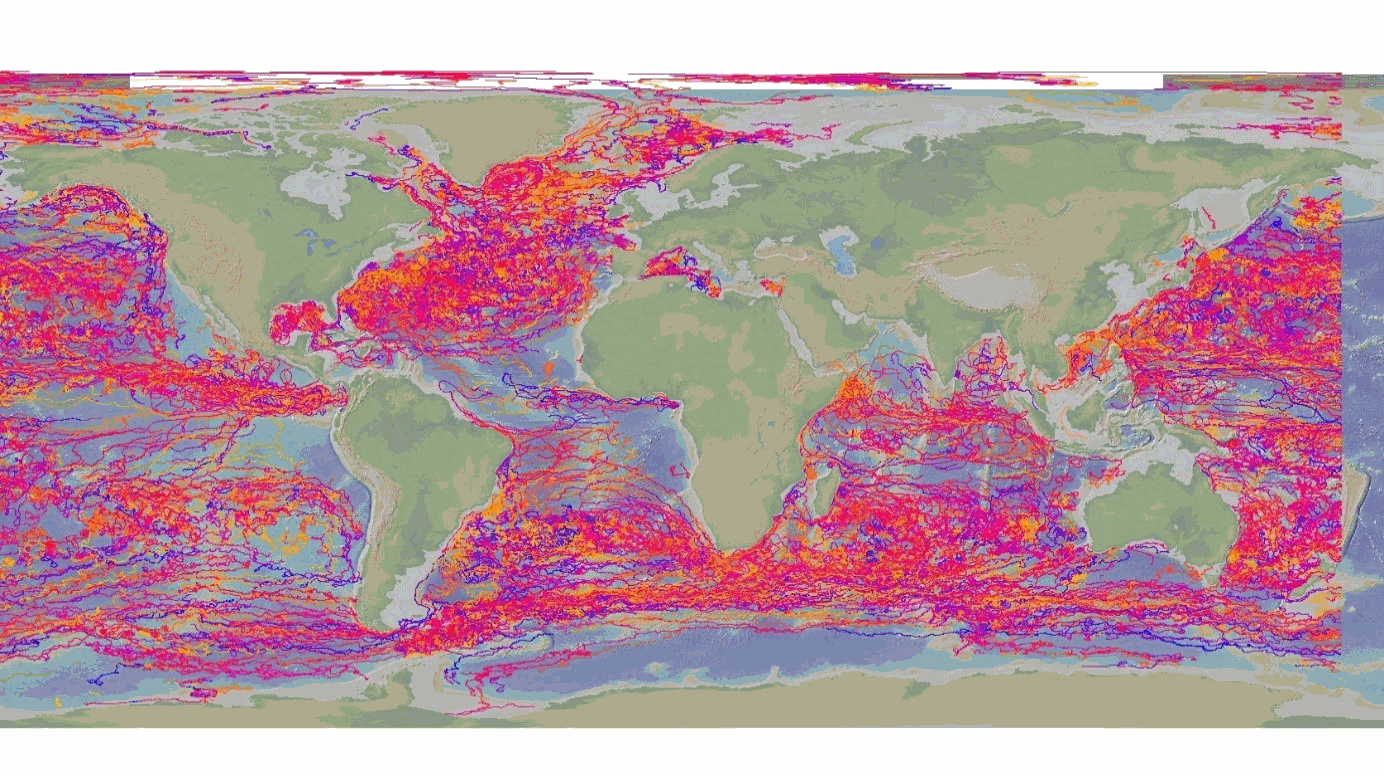
C-RAID: Comprehensive Reprocessing of Drifting Buoy Data (1979-2018) The C-RAID (Copernicus - Reprocessing of Drifting Buoys) project delivers a comprehensive global reprocessing of historical drifting buoy data and metadata, providing climate-quality observations for marine and atmospheric research. Dataset Overview The C-RAID dataset encompasses metadata from 21 858 drifting buoys deployed between 1979 and 2018. Of these, 17 496 buoys have undergone complete reprocessing with scientific validation in delayed mode, including comparison against ERA5 reanalysis. Project Context Managed by the WMO DBCP Drifting Buoys Global Data Assembly Centre (GDAC) through Ifremer, Météo-France, and Ocean Sciences Division of Fisheries and Oceans Canada, C-RAID focuses on enhanced quality control and delivery of climate-quality drifting buoy data for the Marine Climate Data System (MCDS). Objectives - Complete reprocessing and clean-up of the historical drifting buoy data archive - Recovery and rescue of missing datasets - Reprocessing of Argos data with improved positioning using Kalman filter algorithms - Homogenization of quality control procedures across marine and atmospheric parameters Funding & Governance C-RAID was funded by the Copernicus Programme through the European Environment Agency (Contract # EEA/IDM/15/026/LOT1), supporting cross-cutting coordination activities for the in-situ component of Copernicus Services. Stakeholders & Partnerships The project is led by the DB-GDAC consortium (Ifremer, Météo-France) in collaboration with EUMETNET's E-SURFMAR programme, NOAA AOML, and JCOMMOPS. Key Achievements - Reprocessing of approximately 24 000 buoy-years of observations - Recovery of missing datasets and metadata through data rescue efforts - Implementation of homogeneous, rich metadata and data formats - Enhanced Argos location accuracy using Kalman filter reprocessing - Standardized quality control and validation procedures Data Access & FAIR Principles C-RAID provides FAIR (Findable, Accessible, Interoperable, Reusable) data access through: - Web-based data discovery portal for human users - API services for data discovery, subsetting, and download (machine-to-machine access) Target Users The dataset serves major operational and research programmes including: - Copernicus Climate Change Service (C3S) - Copernicus Marine Environment Monitoring Service (CMEMS) - iQuam (in-situ SST Quality Monitor) - ICOADS (International Comprehensive Ocean-Atmosphere Data Set) - GHRSST (Group for High Resolution Sea Surface Temperature) - ISPD (International Surface Pressure Databank) - ICDC (Integrated Climate Data Center)
-
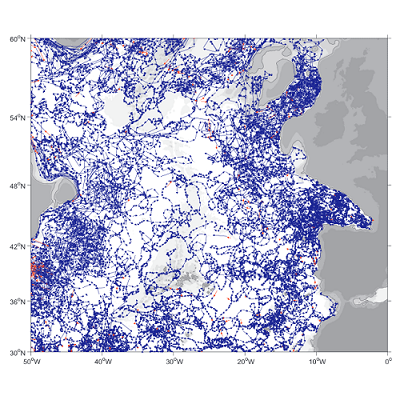
Un jeu de données mondial sur les déplacements en profondeur, nommé ANDRO, d'après une danse traditionnelle de la Bretagne signifiant un tourbillon, comprenant plus de 600 000 déplacements en profondeur, a été produit à partir des données Argo float. Une caractéristique importante de l’ANDRO est que les pressions mesurées lors de la dérive des flotteurs en profondeur, et convenablement moyennées, sont conservées dans ANDRO . Pour atteindre cet objectif, il était nécessaire de retraiter la plupart des données brutes Argo, en raison des nombreuses versions de décodage différentes (environ 100) pas toujours appliquées par les CNA aux données de déplacement, car ils étaient principalement intéressés par les paramètres p, t, S. profils. Le résultat de nos travaux a été la production de fichiers complets, nommés DEP, contenant toutes les données flottantes éventuellement récupérables. Le contenu et le format actuels d'ANDRO sont décrits dans le guide de l'utilisateur http://archimer.ifremer.fr/doc/00360/47126/, qui doit être lu avant d'utiliser ANDRO (le format ANDRO est également décrit dans Ollitrault M. et al (2013) http://archimer.ifremer.fr/doc/00138/24901/ ).