 Catalogue PIGMA
Univ. Bordeaux, CNRS, Bordeaux INP, EPOC, UMR 5805, F-33600 Pessac, France
Type of resources
Available actions
Topics
Keywords
Contact for the resource
Provided by
Years
Formats
-
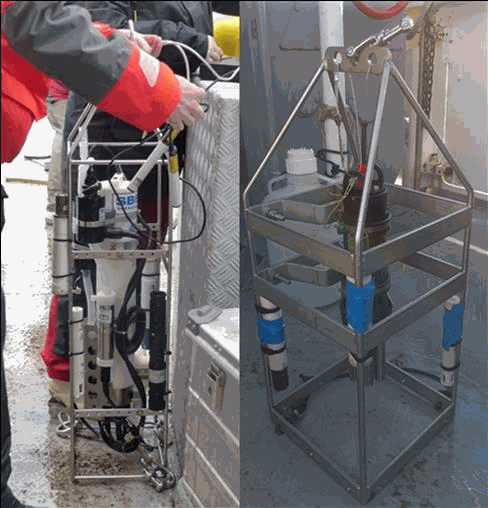
The aim of this work was to document the seasonal and inter-annual dynamic of dissolved oxygen and ancillary data (T, S, Chl-a, turbidity, pH) along a cross-shelf transect off the Gironde estuary. This work has been motivated by recent simulations that suggest the occurrence of seasonal bottom deoxygenations in this River-dominated Ocean Margin (Riomar); but unfortunately there were no data sets to test this hypothesis until now. Profiles of temperature, salinity and dissolved oxygen were performed in the water column of the West Gironde Mud Patch off the Gironde estuary (from 45°46.383’N – 1°28.925’W to 45°35.524’N - 1°50.689’W) during seven cruises on the R/V Côte de la Manche (doi: 10.18142/284 ; 10.17600/18000861) between 2016 and 2021 (October 2016, August 2017, January 2018, April 2018, July 2019, April 2021, October 2021). Turbidity was measured in January and April 2018, July 2019 and October 2021, Chl-a in October 2016, August 2017, January 2018, April 2018 and July 2019 and pH in October 2021. This dataset had permitted to validate the occurrence of bottom deoxygenations when the water column is stratified.
-

This set of data documents the radiocarbon dates (n=19) obtained thanks to the accelerator mass spectrometry method (AMS) at the LMC14/ARTEMIS French national facility on the cores (Multicorer, Kullenberg) retrieved from the West-Gironde mud patch (WGMP) during the JERICObent-7 cruise (10-15 July 2019; NR Côtes de la Manche, https://doi.org/10.17600/18001022). The WGMP registers very high sedimentation rates since the last 600 years (≥ 0.3 cm/yr) and is thus of great interest for palaeoceanographic investigations. At present, this depocenter marks the mid-shelf of the temperate Bay of Biscay off major French rivers from the Aquitaine basin. The fine mud deposits of the WGMP are of 3 to 4 meters thick and lie on palimpsest levels rich in gravels and shells. They cover a V-shaped structure, oriented SW-NE, which is attributed to the incision(s) of a paleovalley in the Cenozoic substrate, mainly linked to the paleo-Gironde routing changes during past glacials/interglacials, and its potential past convergences with the paleo-rivers of the Antioche perthuis (Seudre, Charente paleovalleys?) at that times. Detailed information on each sample is presented with the 14C results obtained by the Artemis AMS facility at LMC14 laboratory (Dumoulin et al. 2017- https://doi.org/10.1017/RDC.2016.116, Beck et al. 2024- https://doi.org/10.1017/RDC.2023.23). Raw ages are indicated together with calibration calculations using the last two versions of the Calib software (http://calib.org/, Calib 7 and 8) to show the dispersion of ages linked to the updating of calibration curves (Marine13, Intcal13, Marine20, Intcal 20). The calibrated ages finally retained for publications (used in the related Seanoe document - https://doi.org/10.17882/104237 - and published in Eynaud et al., 2025 for the ST3c core, https://doi.org/10.1016/j.gloplacha.2025.105039) are those obtained with the last Calib 8.1 version. Raw 14C ages were calibrated and converted to calendar ages using the IntCal20 calibration curve with a reservoir age correction of 400 years deduced from Radionuclide analyses (137Cs and 210Pb) at the top of the studied cores (see Schmidt, 2025, https://www.seanoe.org/data/00968/107979/).
-
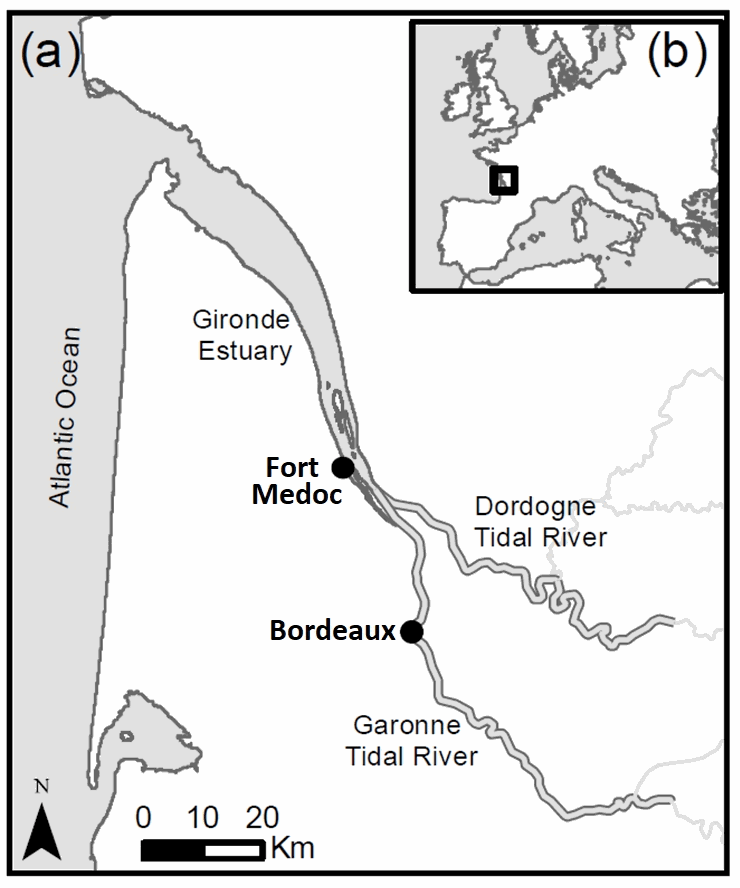
In the context of EMPHASE project (ANR-FRQ), two fields campaigns were carried out to determine the settling velocity and properties of suspended sediments during a semi-diurnal tidal cycle, as well as hydrodynamic conditions and water properties. The two sampling stations Bordeaux (Garonne Tidal River) and Fort Medoc (Gironde EStuary) were representative of two regions: a tidal river dominated by fresh water and an estuary affected by salty or brackish waters, inside the same land-sea continuum. Quasi in-situ measurements of settling velocity were carried out with a recently-patented instrument named System for the Characterisation of Aggregates and Flocs (SCAF).