 Catalogue PIGMA
CTD-O2
Type of resources
Available actions
Topics
Keywords
Contact for the resource
Provided by
Years
Formats
-
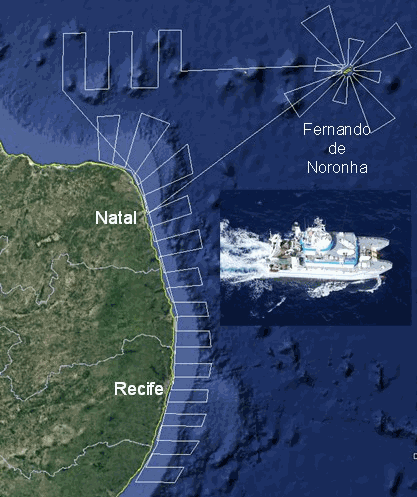
Physical data associated with the ABRACO2 cruise. The ABRACOS2 cruise's main objective was to draw up a 3D characterisation of the abiotic and biotic compartments and their interactions. The cruise had 3 specific objectives: 1) Characterisation of water masses and their dynamics. Data collected (ADCP, CTD, rosette, etc.) will be used to study the physical connections between (i) ocean islands and coastal ecosystems and (ii) tropical/subtropical coastal regions to the South and equatorial coastal regions to the North. In-situ measurements will also make it possible to validate the regional high-resolution hydrodynamic models. 2) Ecosystem acoustics. Collecting multifrequency acoustic data in order to create the first 3D characterisation of island and coastal ecosystems in the Northeast Region of Brazil. Acoustic observations will be combined with sampling with pelagic trawl (Legs 1 and 2), bottom trawl (Leg 1), and with sampling of zooplankton and video images. 3) Biodiversity and food web structure. In-situ sampling will provide information about the distribution, biodiversity, trophic ecology (use of stable isotopes) and the contamination (methylmercury) of organisms. The related projects are ABRAÇOS and 'Planning in a liquid world: Marine spatial planning and network dynamics' (PADDLE), (H2020 RISE), (PI: M. Bonnin, 2017-2020).
-
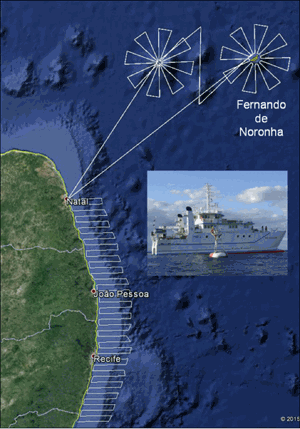
Physical data associated with the ABRACO cruise. The ABRACOS (Acoustics along the BRAzilian COaSt) cruise aims to begin an integrated approach to monitoring the tropical marine ecosystems in the Brazilian Nordeste region in order to better understand the connectivity between the sub-systems composing it. In particular, this cruise should fill this gap and improve understanding of the degree of connectivity which exists between the oceanic islands and the continental margin in the Nordeste of Brazil, as well as within the continental platform. In this context, the main objective of the ABRACOS cruise consisted in drawing up a 3D characterization of abiotic and biotic compartments and their interactions in the Brazilian Nordeste. Specific objectives: Objective 1 - Characterization of island and coastal dynamics. Measurement of hydrological characteristics and currents (rosette, CTD, ADCP) should enable the circulation and characteristics of water masses to be described. These data will be more specifically used to study the physical connections between 1) the oceanic islands and coastal ecosystems and 2) the coast along the ocean and coastal zones. The in-situ measurements obtained will also be used to validate high resolution regional hydrodynamic models (e.g. ROMS model) which will be implemented. In-situ data acquired during the ABRACOS cruise will be supplemented by satellite data for sea surface heights (e.g. AVISO), surface temperature and chlorophyll (e.g. MODIS) and wind (e.g. ASCAT). However, it should be noted that the resolution of the products usually used and land-ocean interferences on altimetry and backscatter data will not allow these products to be used at less than 30-50 km from the coast. We will be able to partially eliminate this problem by using new "alongtrack" processing of altimetric data performed by the Center for Topographic studies of the Ocean and Hydrosphere in Toulouse. These data will be used to document the geostrophic (from sea level) ageostrophic (from wind) components of surface circulation and their variability in coastal zones. Objective 2 - Ecosystem acoustics. Acoustic tools can provide the simultaneous acquisition of quantitative and qualitative data, at different spatial-temporal scales, in numerous biotic and abiotic compartments of an ecosystem. These data can be used to characterize the ecosystem in three dimensions and directly study interactions between compartments. Active acoustics have rarely been used in tropical coastal zones. The multifrequency (38, 70, 120, and 200 kHz) acoustic data acquired during the ABRACOS cruise will be used to create an initial 3D characterization of island and coastal ecosystems in the Brazilian Nordeste region, simultaneously characterizing the seabed and water column, when possible. The French team proposing this has sound experience in the field and developed the open source 'Echopen' software in Brest (www.france-nord.ird.fr/lesressources/outils-informatiques) which can separate the various sources of acoustic echoes (e.g. zooplankton, gelatinous organisms and fish) from multifrequency acoustic data. In order to calibrate the 'Echopen Brésil' version, acoustic observations from the ABRACOS cruise must be combined with sampling using micronekton, mesopelagic and bottom trawls (Leg 2 only) and sampling of zooplankton at fixed stations (bongo and WP2 plankton nets and phytoplankton nets). To validate the 'Echopen substrat' tool we will use sampling done with bottom trawl, substrate grab and video camera observations. Objective 3 - Biodiversity and trophic structure. As indicated, acoustic observations will be complemented by in-situ sampling of planktonic, pelagic (mid-water trawls) and demersal-benthic (bottom trawl) organisms. This will involve establishing how hydrological conditions determine the vertical distribution of organisms and therefore interactions. One part of the sampled organisms will be conserved in formaldehyde then identified by taxonomists at the Federal university of Rio de Janeiro (UFRJ) to be added to Brazilian collections. The remainder of the samples will be used to obtain biological information. Along with the classic biological measurements (size, weight, sex, maturity, etc.) specimens of entire organisms (plankton) and soft tissues (muscles) will be taken in order to titrate various trophic tracers: stable isotopes of carbon, nitrogen and insofar as possible mercury. In addition, particulate organic matter (POM) will be collected by filtration (samples taken by rosette) to titrate the amounts of stable isotopes. Spatial variations in these tracers will make it possible to highlight the relative positions of these organisms in the food web and variations in food sources through the local POM signatures. Measurements of methylmercury (MeHg), a neurotoxin which accumulates in the food chain, will also be performed on part of the samples used for stable isotopes. The related projects are ABRACOS and Action Incitative IRD "DANOB".
-
Physical data associated with the AMAZOMIX cruise. The Amazon shelf encompasses a variety of physical processes, such as fluvial inputs, coastal currents, mesoscale, filaments, tides, internal waves and upwelling, influencing nutrient concentrations, chlorophyll and suspended matter. They also affect energy, salt and heat balances; parameters that condition physical/biogeochemical interactions and ecosystem functioning, from bacteria to plankton to fish resources. In particular, internal tidal waves are very energetic in this region. They impact biogeochemical cycles via the vertical mixture induced by their dissipation or vertical movements induced by their propagation. They thus allow a significant input of nutriments into the euphotic layer enhancing primary production, as observed on the surface from watercolour data. Internal tidal waves could thus influence the biological pump and the carbon cycle. In addition, overall marine biodiversity of the region, from bacteria to fish is not well described. The connectivity of species in the tropical Atlantic is also still an open question. The Caribbean region is by far more bio-diverse than the Brazilian one. One of the hypotheses is that the Amazon plume, which can extend up to 3,000 km off the mouth, would constitute a barrier for some organisms. The Amazon Shelf is thus an ideal experimental laboratory to study the impact of physical processes on the structure and function of neritic and oceanic marine ecosystems. In this context, the objective of the multidisciplinary AMAZOMIX survey was to study the impact of the Amazon River plume, internal tides and associated turbulent mixing, on marine ecosystem in contrasting regions off the Amazon shelf. For that purpose, the multidisciplinary AMAZOMIX project brings together physicists, biogeochemists, bioopticians and biologists. The sampling strategy consists in the simultaneous acquisition of a comprehensive set of environmental and biological compartments, including micro-organisms (bacteria, phyto and zooplankton) and higher trophic levels (micronekton, demersal and pelagic fish). AMAZOMIX is the first campaign to develop this multi-disciplinary approach off the Amazon shelf. In situ results will be analysed in interaction with digital tools and data, modelling (1/36°, with and without tides, 1/12° coupled) and satellite data analyses. This dataset contains the AMAZOMIX 2021 qualified measurements of - The hydrographic CTD-02 (netCDF and csv text files) - Ship Acoustic Doppler Current Profilers (OS 75 kHz, netCDF and csv text files) - Lowered Acoustic Doppler Current Profilers (WH300 downlooking and WH300 uplooking, netCDF and csv text files) - Thermosalinometer (netCDF and csv text files) - Vertical microstructure profile (VMP-250, binary file)