 Catalogue PIGMA
Carbon dioxide
Type of resources
Available actions
Topics
Keywords
Contact for the resource
Provided by
Years
Formats
-
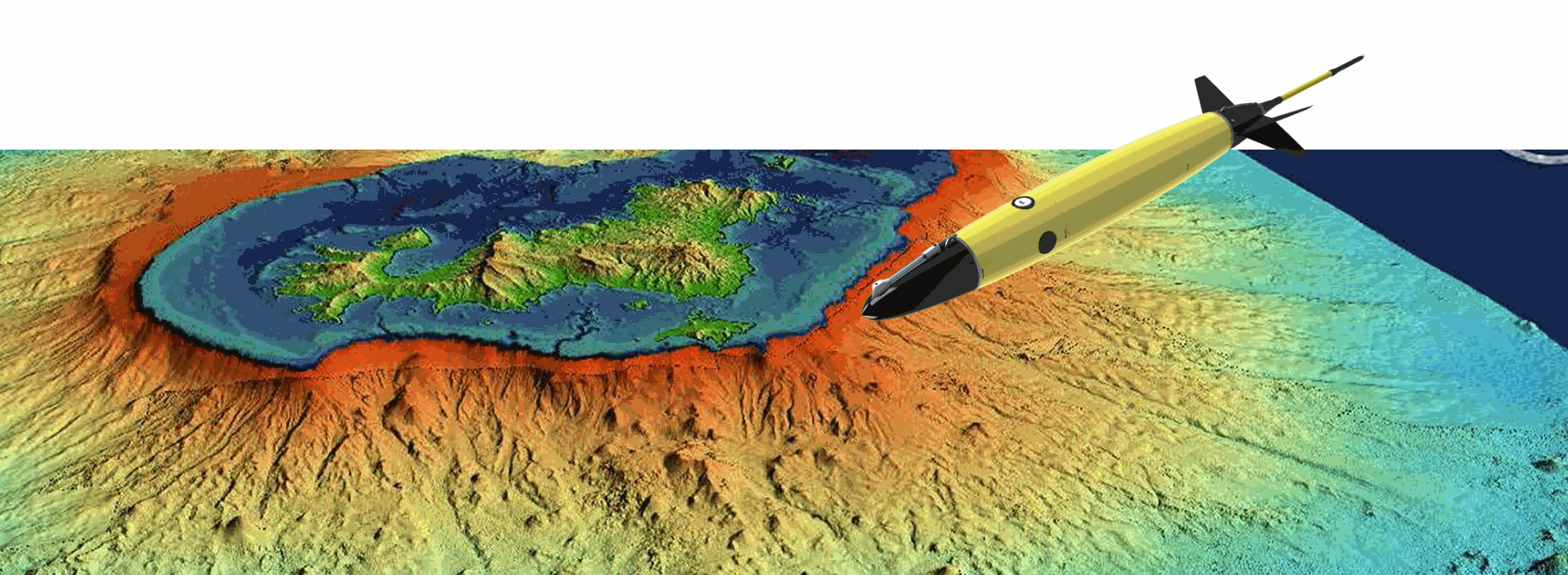
In May 2018, an unprecedented long and intense seismic-volcanic crisis broke out off the island of Mayotte (Indian Ocean) and was associated with the birth of the Fani Maoré underwater volcano. Since then, an integrated observation network has been created (REVOSIMA), with the given objective of monitoring and better understanding underwater volcanic phenomena. Recently, an unmanned submarine glider (SeaExplorer) has been deployed to supplement the data obtained during oceanographic surveys (MAYOBS) which are carried out on an annual basis. This glider is operated by ALSEAMAR and performed a continuous monitoring of 30 months of the water column with the objective to acquire hydrological properties, water currents and dissolved gas concentrations. This monitoring already showed that it is feasible and valuable to measure autonomously, continuously and at a high spatio-temporal scale, physical (TEMP, SAL, water currents) and biogeochemical parameters (O2, CH4, PCO2, bubbles/droplets, vertical speeds) over several months from a SeaExplorer glider. In particular, innovating sensing capabilities (e.g., MINI-CO2, ADCP) have shown a great potential in the context of the Mayotte seismic volcano crisis, despite technical challenges (complex algorithms, sensor capabilities, etc.). This dataset provides these physical and biogeochemical parameters from September 17, 2021 to April 02, 2024 and the quality flags associated.
-

This database consists of several time series recorded at 30-minute intervals on the ASTAN cardinal buoy, located 3.1 km offshore from Roscoff in the western English Channel (France). It was originally developed by Gac et al. (2020, DOI:10.3389/fmars.2020.00712). The present version corresponds to the dataset used in Robache and Schmitt (2025, DOI:10.5194/egusphere-2025-972). Sea surface temperature (SST, °C) and salinity (SSS, psu) were recorded using a SeaBird Inc. SBE16+ sensor. Dissolved Oxygen (DO) and chlorophyll a (chl a, µg L-1) concentrations were respectively recorded with a SeaBird Inc. SBE43 sensor and a Cyclops7 sensor. Oxygen saturation (Osat, %) was estimated by Gac et al. (2020) following the method of Weiss (1970, DOI: 10.1016/0011-7471(70)90037-9). Atmospheric pressure (Patm, hPa) data were obtained from the weather station at the Roscoff Marine Station. The seawater surface partial pressure of CO2 (pCO2, µatm) data was collected on the buoy using a SAMI-CO2 sensor (SunBurst Sensors).