Keyword

Atmospheric pressure

13 record(s)
 
Type of resources
Available actions
Topics
Keywords
Contact for the resource
Provided by
Years
Formats
Representation types
Update frequencies
status
Scale
From 1 - 10 / 13
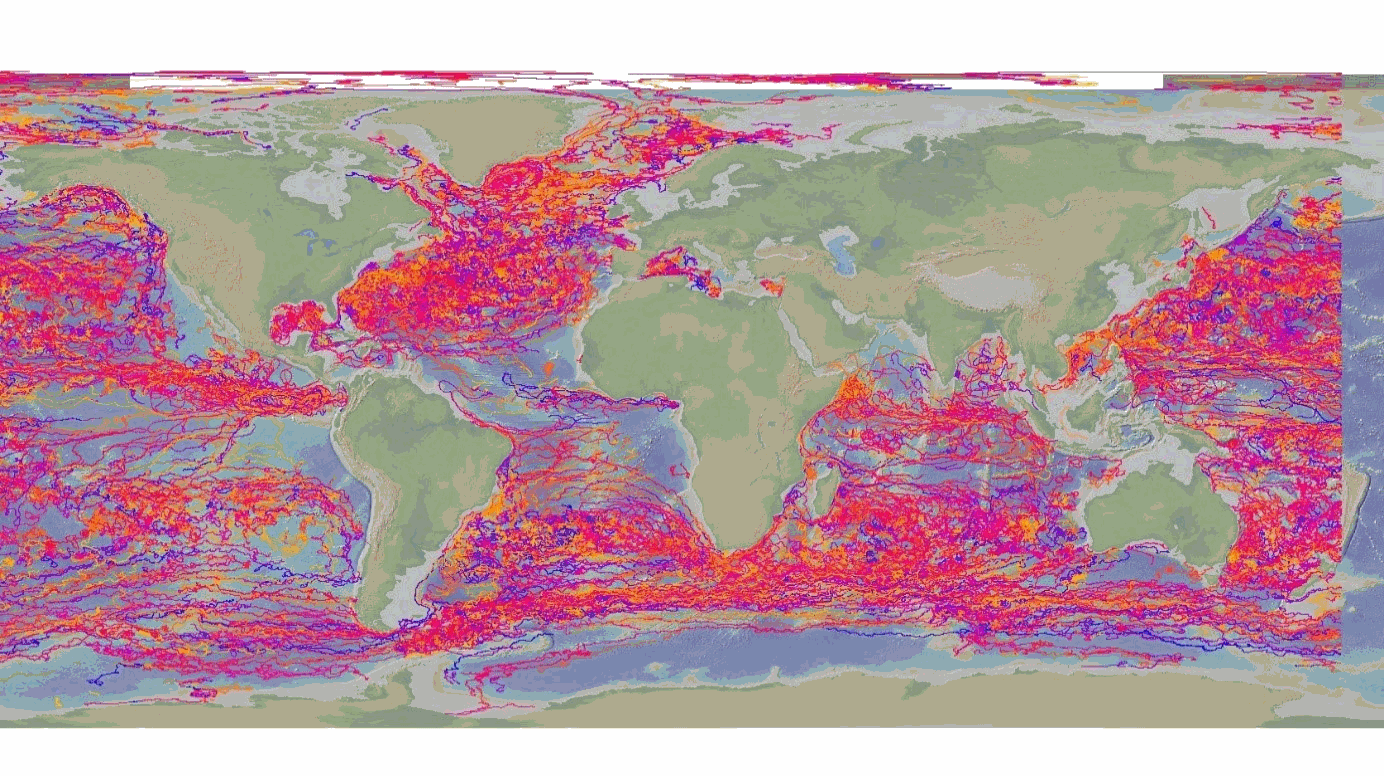
  • The DBCP – Data Buoy Cooperation Panel - is an international program coordinating the use of autonomous data buoys to observe atmospheric and oceanographic conditions, over ocean areas where few other measurements are taken. DBCP coordinates the global array of 1 600 active drifting buoys (August 2020) and historical observation from 14 000 drifting buoys. Data and metadata collected by drifting buoys are publically available in near real-time via the Global Data Assembly Centers (GDACs) in Coriolis-Ifremer (France) and MEDS (Canada) after an automated quality control (QC). In long term, scientifically quality controlled delayed mode data will be distributed on the GDACs. Disclaimer: the DB-GDAC is under construction. It is currently (January 2020) aggregating data from the Coriolis DAC (E-Surfmar, Canada). Additional DACs are considered. An interim provision from GTS real-time data to GDAC may be provided from Coriolis DAC.  

  • The CORE-II simulations provide a framework to evaluate ocean model performance, to study mechanisms of ocean phenomena and their variability from seasonal to decadal timescales, to identify forced variability changes, and to develop mechanistic descriptions of observed climate variability and change.

  • The Drifting Buoys GDAC -Global Data Assembly Centre- is the repository of surface drifters data. Both NRT -Near Real Time- and DM -Delayed Mode- data are available on the GDAC. Drifters report generally trajectories, sea-surface temperatures, atmospheric pressures at sea-level, as well as sea-surface salinity or sub-surface temperature in the ocean top layer.

  • The Surface Ocean CO₂ Atlas (SOCAT) is a synthesis activity for quality-controlled, surface ocean fCO₂ (fugacity of carbon dioxide) observations by the international marine carbon research community (>100 contributors). SOCAT data is publicly available, discoverable and citable. SOCAT enables quantification of the ocean carbon sink and ocean acidification and evaluation of ocean biogeochemical models. SOCAT represents a milestone in biogeochemical and climate research and in informing policy. SOCAT data are released in versions. Each succeeding version contains new data sets as well as updates of older ones. The first version of SOCAT was released in 2011, the second and third version followed biennially. Automation allowed annual public releases since version 4. The latest SOCAT version (version 5) has 21.5 million observations from 1957 to 2017 for the global oceans and coastal seas. SOCAT contains data from the VOS, OceanSites network and mooring, buoy data in general as well as calibrated sensor data.

  • The Global Sea Level Observing System (GLOSS) was established by the Intergovernmental Oceanographic Commission (IOC) of UNESCO in 1985 to establish a well-designed, high-quality in situ sea level observing network to support a broad research and operational user base. Various tide gauge networks have contributed to GLOSS, each with a different focus and each changing over time as research priorities evolve. The main component is the GLOSS Core Network (GCN), a global set of ~300 tide gauges that serves as the backbone of the global in situ sea level network. GCN gauges were allocated to each island or group of islands at intervals not closer than 500 km, and along continental coasts at intervals generally not less than 1000 km. Preference was given to islands in order to maximise exposure to the open ocean. Established in 1933, the Permanent Service for Mean Sea Level (PSMSL) is responsible for the collection, publication, analysis and interpretation of sea level data from the global network of tide gauges, including the GLOSS Core Network.

  • The mission of OceanSITES is to collect, deliver and promote the use of high-quality data from long-term, high-frequency observations at fixed locations in the open ocean. OceanSITES typically aim to collect multidisciplinary data worldwide from the full-depth water column as well as the overlying atmosphere. OceanSITES delivers high-quality data from long-term, high-frequency observations at fixed locations in the open ocean.

  • Data from FerryBoxes on ships of opportunity going on permanent routes are stored inside this database (ferrydata.hzg.de). Parameters are temperature, salinity, chlorophyll-a fluorescence, oxygen and different others. The data model is transect oriented. A data portal to access and visualise the data is also provided.

  • '''Short description: ''' For the Global Ocean- The In Situ Thematic Assembly Centre (INS TAC) integrates near real-time in situ in situ observation data. These data are collected from main global networks (Argo, GOSUD, OceanSITES, GTS) completed by European data provided by EUROGOOS regional systems and national data providers assembled by the In Situ TAC regional components. The data are quality controlled using automated procedures and assessed using statistical analysis residuals. It is updated continuously and provides observations with 24-48 hours from acquisition in average. Acces through CMEMS Catalogue after registration: http://marine.copernicus.eu/ '''Detailed description:''' Ocean circulation models need information on the interior of the ocean to be able to generate accurate forecast. This information is only available from in-situ measurements. However this information is acquired all around the world and not easily accessible to operational users. Therefore, In Situ Thematic Assembly Centre (INS-TAC), by connecting to a lot of international networks, collects, controls and disseminates the relevant in-situ data to operational users and research community. It also integrates the in situ data collected by the regional components of the INS-TAC. The INS-TAC portal is updated continuously with the observations which have never been disseminated in previous release or have been updated. The latest month of data is available in the "latest" directory, while the data are then accumulated month by month on the same portal. '''Processing information:''' The product is the homogeneous aggregation of observation data coming from various in-situ sources, quality controlled according to standardized procedures that have been defined in collaboration with EUROGOOS, SeaDataNet and international programs such as Argo, GOSUD or OceanSITES. Duplicate observations have been removed. The data are coming from the following platforms: # Profile data from Argo profiling floats including Euro-Argo, CTD and XBT from research vessels or vessels of opportunity, mooring from OceanSITES including EuroSites and National systems, profiles from Gliders including EGO , from sea mammals as well as profile data from GTS (Global Telecommunication System in BUOY, BATHY and TESAC format). # along the track data from thermosalinograph European Ferrybox vessels, Argo profiling floats and drifting buoys . # Timeseries from fixed stations mainly in European seas # sea level from EUROGOOS ROOSesThe reference level of the measurements is immersion (in meters) or pressure (in decibars). The data are available in the same format on a unique portal develop jointly with EurOGOOS for the European Seas. '''Quality/accuracy/calibration information:''' On each profile or underway data individual automatic tests (peak detection, ....) and statistical tests (comparison with climatology and neighbouring measurements) are performed. On doubtful data visual control by ocean experts is performed. As a result of these tests, quality control flags are assigned to each measurement and included in the product. The data format and Quality Control procedures for Temperature, Salinity, Current, Sea Level , and some biogeochemical parameters are documented at CMEMS INS-TAC Documentation. '''Suitability, Expected type of users / uses:''' The product is designed for assimilation into operational models operated by ocean forecasting centres or for scientists interested in near real time products. These users need data aggregated and quality controlled in a reliable and documented manner. As the different releases of the product are not archived by INS TAC, users have to manage their own in-situ data archive if they need it. Only the best copy of the data is archived at the INS TAC.

  • EMODnet Physics provides a combined array of services and functionalities to obtain free-of-charge data, meta-data and data products on the physical conditions of European sea basins and oceans as recorded by more than 20.000 platforms (fixed stations, surface loads, ARGOs, HF radars, etc.) The system provides full interoperability with third-party software through WMS services, Web Services and Web catalogues in order to exchange data and products according to the most recent standards. EMODnet Physics builds on and is based on the cooperation and collaboration with the three established pillars of the European Oceanographic Community: 1) EuroGOOS and its Regional Operational Oceanographic Systems (ROOSs); 2) Copernicus Marine Environment Monitoring Service (CMEMS) , and in particular with the In Situ Thematic Assembly Center (INSTAC); 3) SeaDataNet network of National Oceanographic Data Centres (NODCs). Data are made available by EMODnet Physics, funded by the European Commission Directorate General for Maritime Affairs and Fisheries, in collaboration with Copernicus Marine Service (CMEMS) and EuroGOOS ROOSs INSTAC. Delayed mode data integrates the best available version of in situ data. These data are collected from national observing systems operated by EuroGOOS ROOS members, SeaDataNet NODCs completed by main global networks

  • The in-situ TAC integrates and quality control in a homogeneous manner in situ data from outside Copernicus Marine Environment Monitoring Service (CMEMS) data providers to fit the needs of internal and external users. It provides access to integrated datasets of core parameters for initialization, forcing, assimilation and validation of ocean numerical models which are used for forecasting, analysis and re-analysis of ocean physical and biogeochemical conditions. The in-situ TAC comprises a global in-situ centre and 6 regional in-situ centres (one for each EuroGOOS ROOSs). The focus of the CMEMS in-situ TAC is on parameters that are presently necessary for Copernicus Monitoring and Forecasting Centres namely temperature, salinity, sea level, current, waves, chlorophyll / fluorescence, oxygen and nutrients. The initial focus has been on observations from autonomous observatories at sea (e.g. floats, buoys, gliders, ferrybox, drifters, and ships of opportunity). The second objective was to integrate products over the past 25 to 50 years for re-analysis purposes... Gathering data from outsider organisations requires strong mutual agreements. Integrating data into ONE data base requires strong format standard definition and quality control procedures. The complexity of handling in situ observation depends not only on the wide range of sensors that have been used to acquire them but, in addition to that, the different operational behaviour of the platforms (i.e vessels allow on board human supervision, while the supervision of others should be put off until recovering or message/ping reception)°