 Catalogue PIGMA
wave
Type of resources
Available actions
Topics
Keywords
Contact for the resource
Provided by
Years
Formats
Representation types
Update frequencies
-
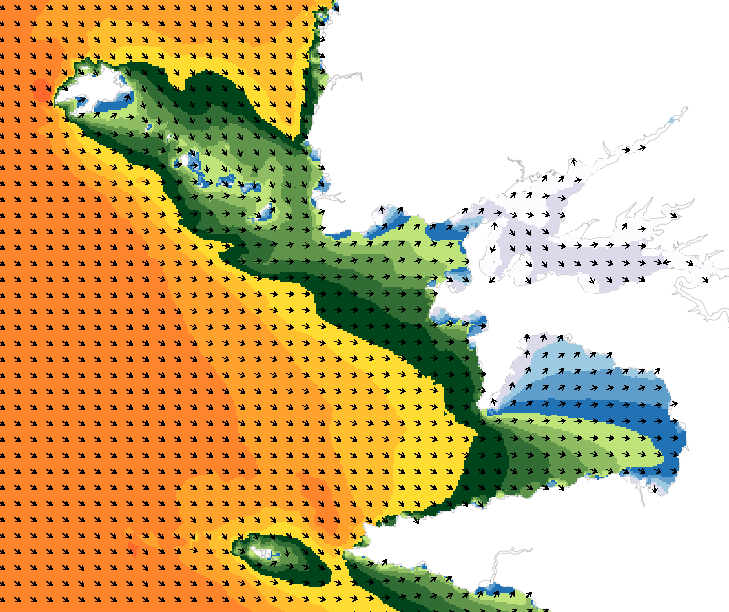
Wave forecasting models allow the representation of sea states based on a spectral resolution at the global scale or at the scale of ocean basins. This code calculates the evolution of the sea state by decomposing it into a wave spectrum that propagates in different directions and with different periods. During the propagation, the wave energy is increased or decreased by the effects of wind, breaking waves and energy exchanges between the different components. The wave forecasts available on data.shom.fr are calculated with 2 different types of models: MFWAM for the offshore domain (resolution from 0.5° to 0.1°) and Wavewatch III ® (WW3) for the coastal domain (resolution from 2' to 200m). MFWAM is a sea state forecasting model (wind wave and swell) derived from the third generation WAM code (WAMDI Group, 1988). Wavewatch III ® (WW3) is developed in a collaboration between the United States Weather Service (NOAA/NCEP), Shom, the University of Darmstadt in Germany, and other partners. The forecasts published on data.shom.fr are issued from the parameterization carried out and optimized by the Shom and Météo-France within the framework of the Homonim project (national coastal flood/wave/storm warning system).
-
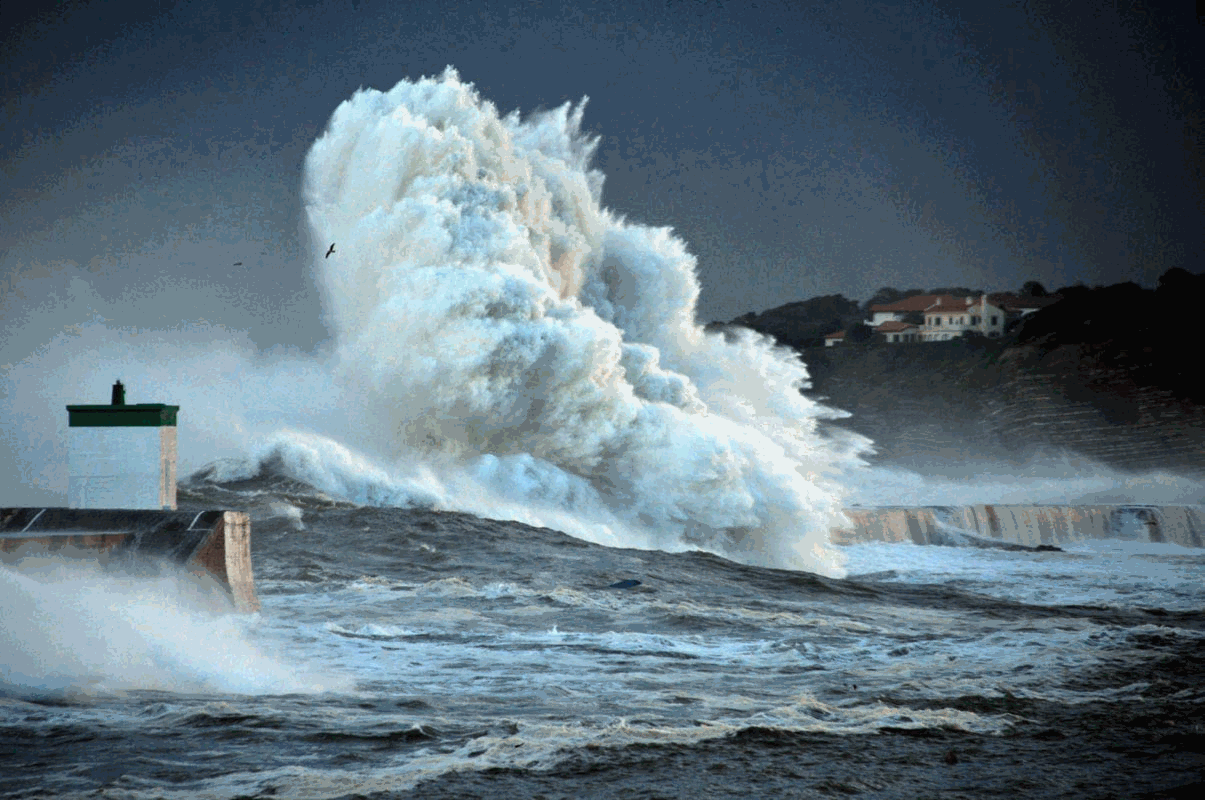
Wave impact is the primary cause of coastal structure failure. While wave impact is widely studied in controlled environments, in situ measurements of wave impact pressure are rare. The results of a campaign to measure wave impact pressure in situ are summarised here. Data were collected from 2016 to 2019 from anchored pressure gauges on the wall of the Artha breakwater in southwestern France. The acquisition frequency is 10 kHz and 10-minute bursts are recorded every hour. Two databases are published, one by burst and one by impact. The burst database summarises the main parameters describing the 10-minute record, while the impact database contains a list of parameters describing each impact.