 Catalogue PIGMA
Simulation data
Type of resources
Available actions
Topics
Keywords
Contact for the resource
Provided by
Years
Formats
Representation types
Update frequencies
status
Scale
Resolution
-
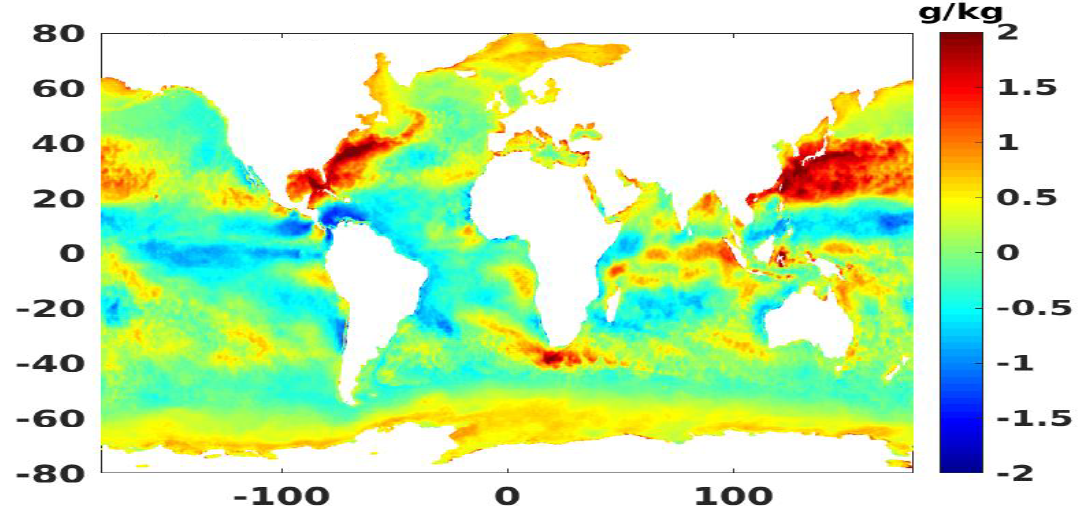
Daily air-sea heat fluxes dataset on the last 27 years (1992-2018). Global coverage with 0.25° resolution. Data is mainly coming from aggregated calibrated scatterometer datasets and numerical models. Main geophysical parameters are: sensible heat flux, latent heat flux, wind speed, SST, air temperature. Latest version : 4.1 released in June 2019.
-
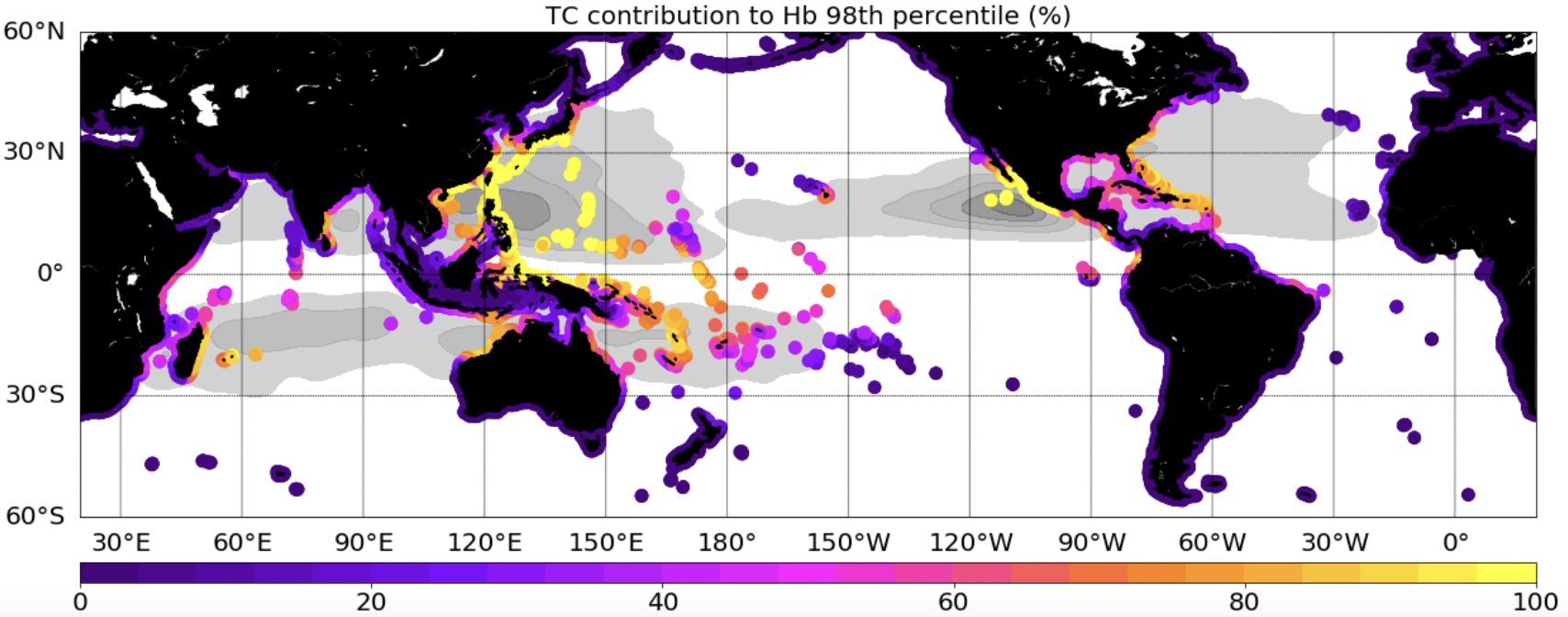
This dataset provides extreme waves (Hs: significant wave height, Hb:breaking wave height, a proxy of the wave energy flux) simulated with the WWIII model, and extracted along global coastlines. Two simulations, including or not Tropical Cyclones (TCs) in the forcing wind field, are provided.
-

This dataset contains some diagnostics of biology of a global ocean simulation coupling dynamics and biogeochemistry at ¼° over the year 2019. The simulation has been performed using the coupled circulation/ecosystem model NEMO/PISCES (https://www.nemo-ocean.eu/), which is here enhanced to perform an ensemble simulation with explicit simulation of modeling uncertainties in the physics and in the biogeochemistry. This dataset is one of the 40 members of the ensemble simulation. This study was part of the Horizon Europe project SEAMLESS (https://seamlessproject.org/Home.html), with the general objective of improving the analysis and forecast of ecosystem indicators. See Popov et al. (https://os.copernicus.org/articles/20/155/2024/) for more details on the study.
-
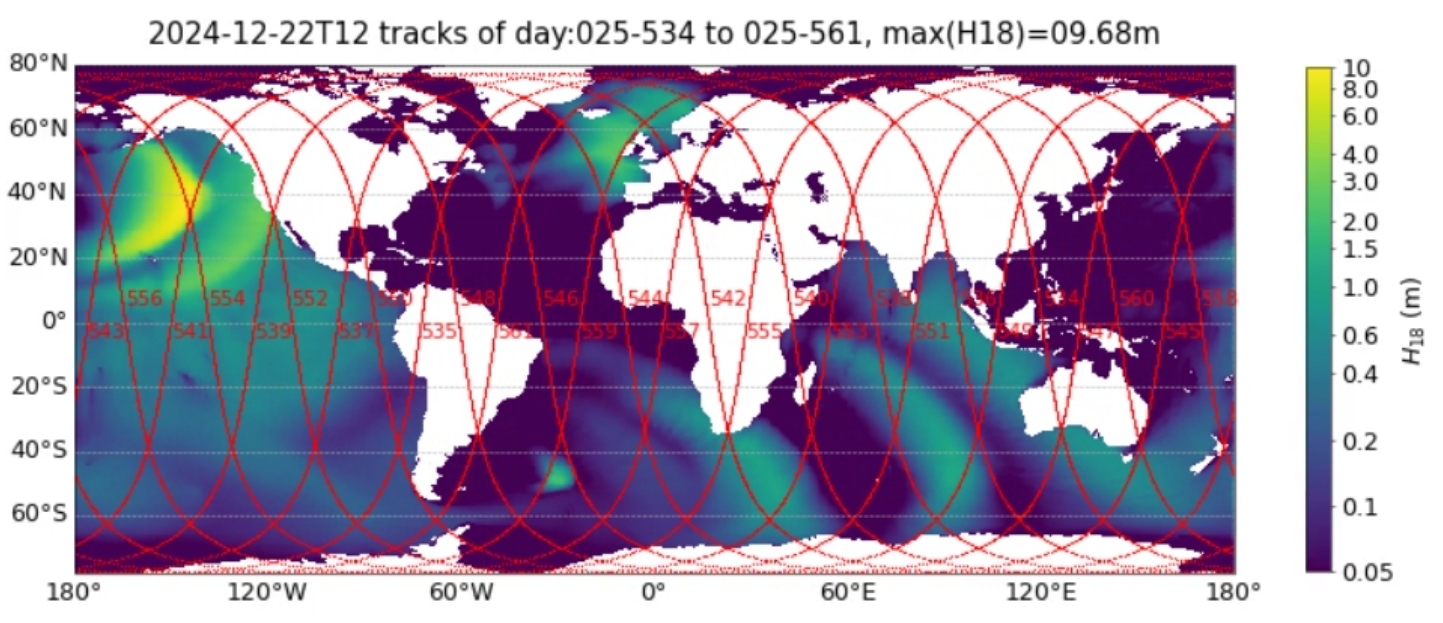
Wave hindcast based on WAVEWATCH III ® with parameterization from Romero (2019) adapted by Alday and Ardhuin (2023) as “TEST702”.
-

The historical Seasonal Sargassum Forecast relies on the system described by Jouanno et al. (2023), operated by at the Laboratoire d’Etude en Géophysique et Océanographie Spatiale (LEGOS) and developed within ANR FORESEA and TOSCA SAREDA projects. This system relies on a mechanistic model of Sargassum populations, the NEMO-Sarg 1.0 model (Jouanno et al. 2021,2023, 2025), which integrates both transport and a physiology model of the macroalgae. The ensemble version of the Sargassum model at 1/4° horizontal resolution has been implemented and allows for the production of 7-month forecasts every month, initialized from Sargassum areal coverage near-real time estimates from the Moderate Resolution Imaging Spectroradiometer MODIS (Berline & Descloitres, 2021). The operational Seasonal Sargassum Forecasts (September 2025 – on going) are produced globally by Mercator Ocean International, building on the same mechanistic NEMO-Sarg 1.0 configuration (Jouanno et al., 2021, 2023, 2025, see details in 2.1). Sargassum biomass is initialized each month using near-real-time estimates derived from OLCI satellite observations (DOI: 10.24400/527896/a01-2022.007), providing an up-to-date representation of surface concentrations. This global operational framework thus complements the IRD regional setup and extends forecasting capability across the entire Atlantic basin. More details on both processing are available in the user manual.
-
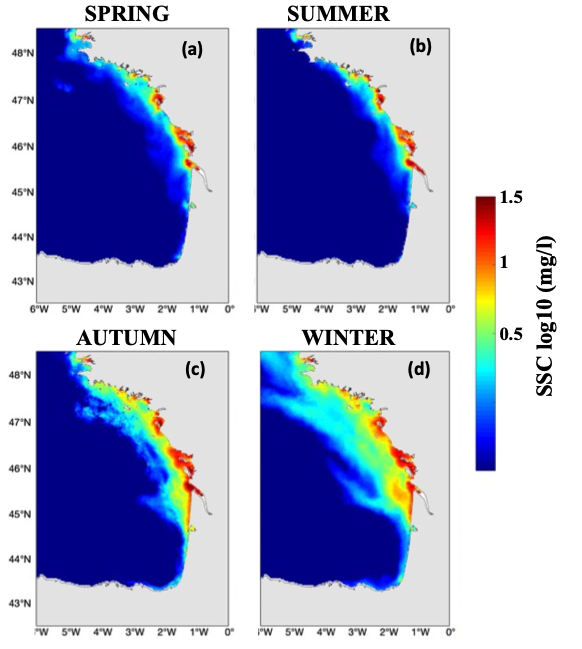
Hydrodynamic and sediment dynamic hindcast modelling with a resolution of 2.5 km in the Bay of Biscay and Channel, produced by coupling the hydrodynamic model CROCO with the sediment dynamic module MUSTANG.
-
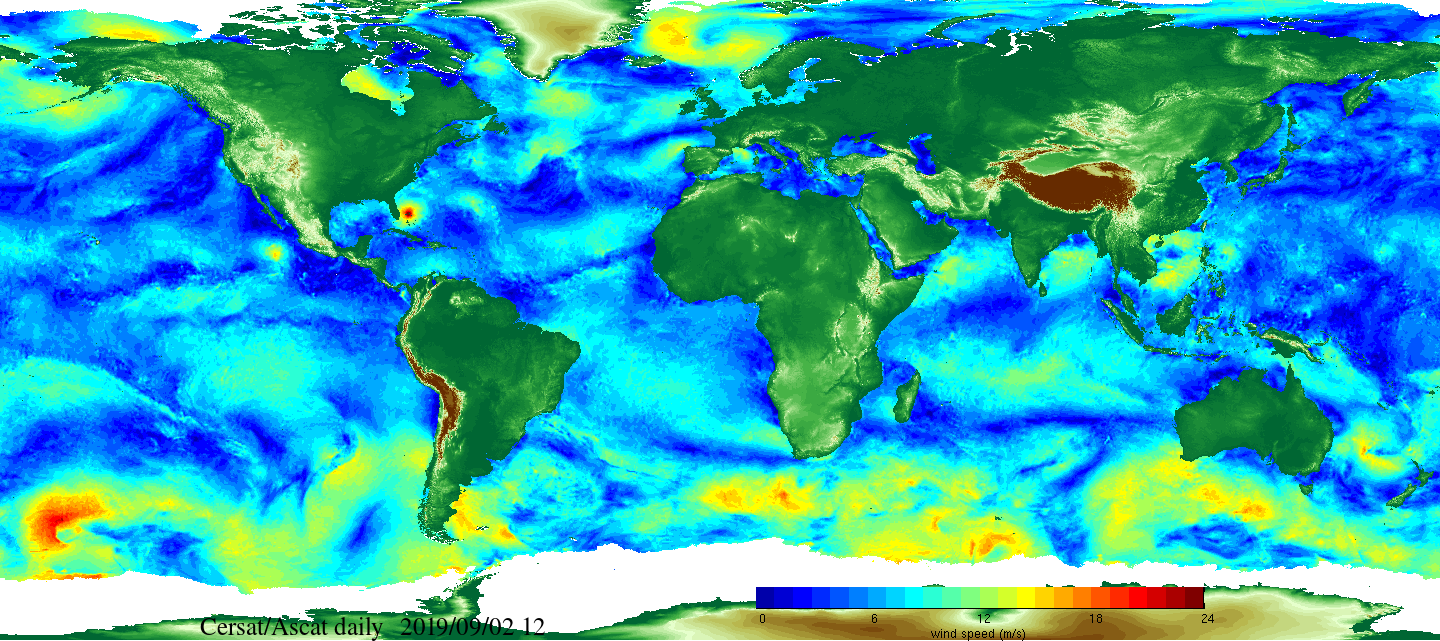
Daily and monthly surface wind analyses are determined as gridded wind products over global oceans, with regular spatial resolution of 0.25° in latitude and longitude. They are estimated from scatterometer wind retrievals (L2b data). According to the scatterometer sampling scheme, the objective method allowing the determination of regular in space surface wind fields uses remotely sensed observations as well as ECMWF analyses. The calculation of daily estimates uses ascending as well as descending available and valid retrievals. The objective method aims to provide daily-averaged gridded wind speed, zonal component, meridional component, wind stress and the corresponding components at global scale. The error associated to each parameter, related to the sampling impact and wind space and time variability, is provided too. Monthly wind analyses are calculated from daily estimates.
-

This dataset contains the outputs of nutrients concentrations of a global ocean simulation coupling dynamics and biogeochemistry at ¼° over the year 2019. The simulation has been performed using the coupled circulation/ecosystem model NEMO/PISCES (https://www.nemo-ocean.eu/), which is here enhanced to perform an ensemble simulation with explicit simulation of modeling uncertainties in the physics and in the biogeochemistry. This dataset is one of the 40 members of the ensemble simulation. This study was part of the Horizon Europe project SEAMLESS (https://seamlessproject.org/Home.html), with the general objective of improving the analysis and forecast of ecosystem indicators. See Popov et al. (https://os.copernicus.org/articles/20/155/2024/) for more details on the study.
-
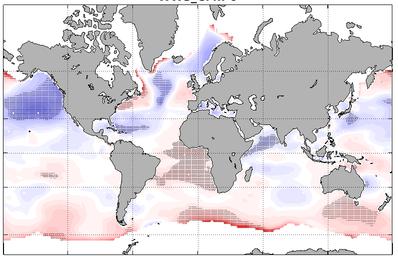
Global wave hindcast (1961-2020) at 1° resolution using CMIP6 wind and sea-ice forcings for ALL (historical), GHG (historical greenhouse-gas-only), AER (historical Anthropogenic-aerosol-only), NAT (historical natural only) scenario.
-
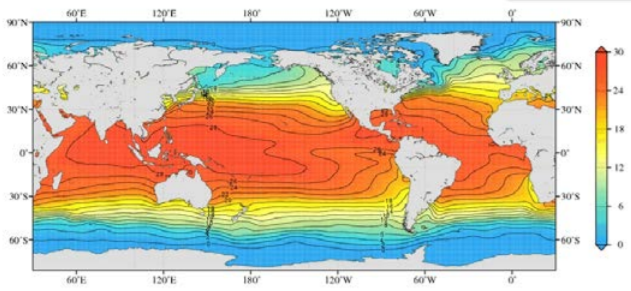
Climatologie de température/salinité de l'océan global basée sur une analyse objective: résolution 1/4° et 1°