 Catalogue PIGMA
ZIP
Type of resources
Available actions
Topics
Keywords
Contact for the resource
Provided by
Years
Formats
Representation types
Update frequencies
status
Scale
Resolution
-
-
-
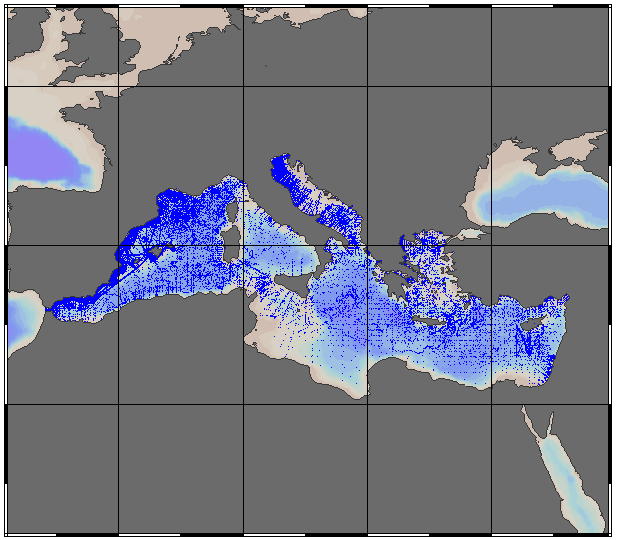
EMODnet Chemistry aims to provide access to marine chemistry data sets and derived data products concerning eutrophication, acidity and contaminants. The chemicals chosen reflect importance to the Marine Strategy Framework Directive (MSFD). ITS-90 water temperature and Water body salinity variables have been also included (as-is) to complete the Eutrophication and Acidity data. If you use these variables for calculations, please refer to SeaDataNet for having the quality flags: https://www.seadatanet.org/Products/Aggregated-datasets . This aggregated dataset contains all unrestricted EMODnet Chemistry data on Eutrophication and Acidity (15 parameters with quality flag indicators), and covers the Mediterranean Sea with 187722 CDI records (180932 Vertical profiles and 6790 Time series). Vertical profiles temporal range is from 1911-08-17 to 2020-10-16. Time series temporal range is from 1974-06-04 to 2018-02-20. Data were aggregated and quality controlled by 'Hellenic Centre for Marine Research, Hellenic National Oceanographic Data Centre (HCMR/HNODC)' from Greece. Regional datasets concerning eutrophication and acidity are automatically harvested and resulting collections are aggregated and quality controlled using ODV Software and following a common methodology for all Sea Regions ( https://doi.org/10.6092/9f75ad8a-ca32-4a72-bf69-167119b2cc12). When not present in original data, Water body nitrate plus nitrite was calculated by summing up the Nitrates and Nitrites. Same procedure was applied for Water body dissolved inorganic nitrogen (DIN) which was calculated by summing up the Nitrates, Nitrites and Ammonium. Parameter names are based on P35, EMODnet Chemistry aggregated parameter names vocabulary, which is available at: https://www.bodc.ac.uk/resources/vocabularies/vocabulary_search/P35/. Detailed documentation is available at: https://dx.doi.org/10.6092/4e85717a-a2c9-454d-ba0d-30b89f742713 Explore and extract data at: https://emodnet-chemistry.webodv.awi.de/eutrophication%3EMediterranean The aggregated dataset can also be downloaded as ODV collection and spreadsheet, which is composed of metadata header followed by tab separated values. This spreadsheet can be imported to ODV Software for visualisation (More information can be found at: https://www.seadatanet.org/Software/ODV ). The original datasets can be searched and downloaded from EMODnet Chemistry Chemistry CDI Data and Discovery Access Service: https://emodnet-chemistry.maris.nl/search
-
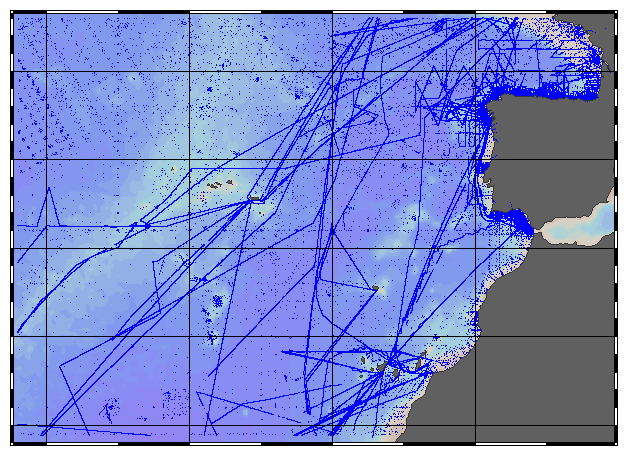
EMODnet Chemistry aims to provide access to marine chemistry data sets and derived data products concerning eutrophication, acidity and contaminants. The chemicals chosen reflect importance to the Marine Strategy Framework Directive (MSFD). ITS-90 water temperature and Water body salinity variables have been also included (as-is) to complete the Eutrophication and Acidity data. If you use these variables for calculations, please refer to SeaDataNet for having the quality flags: https://www.seadatanet.org/Products/Aggregated-datasets. This aggregated dataset contains all unrestricted EMODnet Chemistry data on Eutrophication and Acidity (18 parameters with quality flag indicators), and covers the Northeast Atlantic Ocean (40W) with 381639 CDI records (381085 Vertical profiles and 554 Time series). Vertical profiles temporal range is from 1921-10-15 to 2020-10-16. Time series temporal range is from 1974-06-14 to 2019-04-24. Data were aggregated and quality controlled by 'IFREMER / IDM / SISMER - Scientific Information Systems for the SEA' from France. Regional datasets concerning eutrophication and acidity are automatically harvested and resulting collections are aggregated and quality controlled using ODV Software and following a common methodology for all Sea Regions ( https://doi.org/10.6092/9f75ad8a-ca32-4a72-bf69-167119b2cc12). When not present in original data, Water body nitrate plus nitrite was calculated by summing up the Nitrates and Nitrites. Same procedure was applied for Water body dissolved inorganic nitrogen (DIN) which was calculated by summing up the Nitrates, Nitrites and Ammonium. Parameter names are based on P35, EMODnet Chemistry aggregated parameter names vocabulary, which is available at: https://www.bodc.ac.uk/resources/vocabularies/vocabulary_search/P35/. Detailed documentation is available at: https://dx.doi.org/10.6092/4e85717a-a2c9-454d-ba0d-30b89f742713 Explore and extract data at: https://emodnet-chemistry.webodv.awi.de/eutrophication%3EAtlantic The aggregated dataset can also be downloaded as ODV collection and spreadsheet, which is composed of metadata header followed by tab separated values. This spreadsheet can be imported to ODV Software for visualisation (More information can be found at: https://www.seadatanet.org/Software/ODV ). The original datasets can be searched and downloaded from EMODnet Chemistry Chemistry CDI Data and Discovery Access Service: https://emodnet-chemistry.maris.nl/search
-
-

Les données d'observation des captures en mer sur les navires professionnels, collectées via le dispositif ObsMer, contiennent : les caractéristiques de la marée et des métiers observés (couple engin-espèce cible), la composition des captures (débarquées et rejetées) en taille et en poids par espèce commerciale et scientifique, les potentielles captures accidentelles. Les données présentées ici ont été spécifiquement extraites pour alimenter les indicateurs d'évaluation de la DCSMM relatifs aux espèces de mammifères marins.
-

L'observation des ventes (dispositif ObsVentes) consiste à mesurer périodiquement la taille des individus des principales espèces en criée et aux points de débarquement, en tenant compte des appellations commerciales pratiquées sur les lieux de vente. Les données présentées ici concernent les observations d'espèces amphihalines entre 2003 et 2020.
-

En Atlantique, l’exercice de la pêche maritime dans les estuaires ainsi que l’exercice de la pêche des poissons amphihalins sont soumis à la détention d’une licence de pêche multi-spécifique dénommée « licence CMEA». Elle définit le nombre d’autorisations de pêche pour les espèces estuariennes ainsi que les conditions de pêche. En Méditerranée, la pêche de l'anguille est encadrée par un Arrêté cadre portant création d'une autorisation régionale pour la pêche professionnelle (ARP) de l'anguille (Anguilla anguilla).
-
Rapports présentant les tonnages de livraisons d'engrais minéraux et organo-minéraux par région de 2010 à 2018. Ces données sont issues des campagnes menées par l'UNIFA (Union des industries de la fertilisation) pour le compte du service statistique SSP du ministère de l’Agriculture et de l’Alimentation.
-

L'action Observation à bord des navires de pêche (OBSMER) du SIH consiste en la collecte de données de capture à bord des navires de pêche commerciaux. L'embarquement permet l'observation, sur le lieu de pêche, des parties gardées à bord (le commercial) mais aussi des parties non retenues à bord (les rejets). L'action permet alors de recueillir et produire des données pour répondre aux objectifs suivants : - Estimer les captures totales, retenues et non retenues, par métier et espèce (y compris celles concernées par des règlements spécifiques : thons, requins, espèces profondes) - Noter les captures accidentelles d'autres vertébrés (mammifères, oiseaux, tortues) - Evaluer l'efficacité des dispositifs répulsifs pour les mammifères (expérimentations Pinger) - Caractériser les captures pour tout projet scientifique Les données recueillies portent précisément sur : le métier de pêche en lui-même (stratégies, engins, zones de pêche…) ; la composition de la totalité des captures, commercialisables ou rejetées (espèces, poids, nombre d’individus, distribution en taille, sexe, proportion des rejets, captures accidentelles de mammifères marins...) ; et l’environnement de la marée (météo, saison, localisation de la marée…).