 Catalogue PIGMA
environment
Type of resources
Available actions
Topics
Keywords
Contact for the resource
Provided by
Years
Formats
Representation types
Update frequencies
status
Scale
Resolution
-

Successive infections with Vibrio harveyi were conducted in two populations of the European abalone in order to examine which genes may be involved in improved survival to the disease in the St. Malo population.
-

Présentation de chiffres clés de la filière forêt-bois en région Nouvelle-Aquitaine sur : - les massifs forestiers (2000-2010) - les surfaces boisées (2009-2013) - la récolte (2013/ 2014) - le sciage (2013/ 2014) - le commerce extérieur (2015) - l'emploi (2013) - la formation (2014) - la production et la commercialisation des plants forestiers (2013-2014) - le prix des bois - déstockage (pin maritime) (2008-2015) - le plan gouvernemental suite à la tempête KLAUS (2015)
-
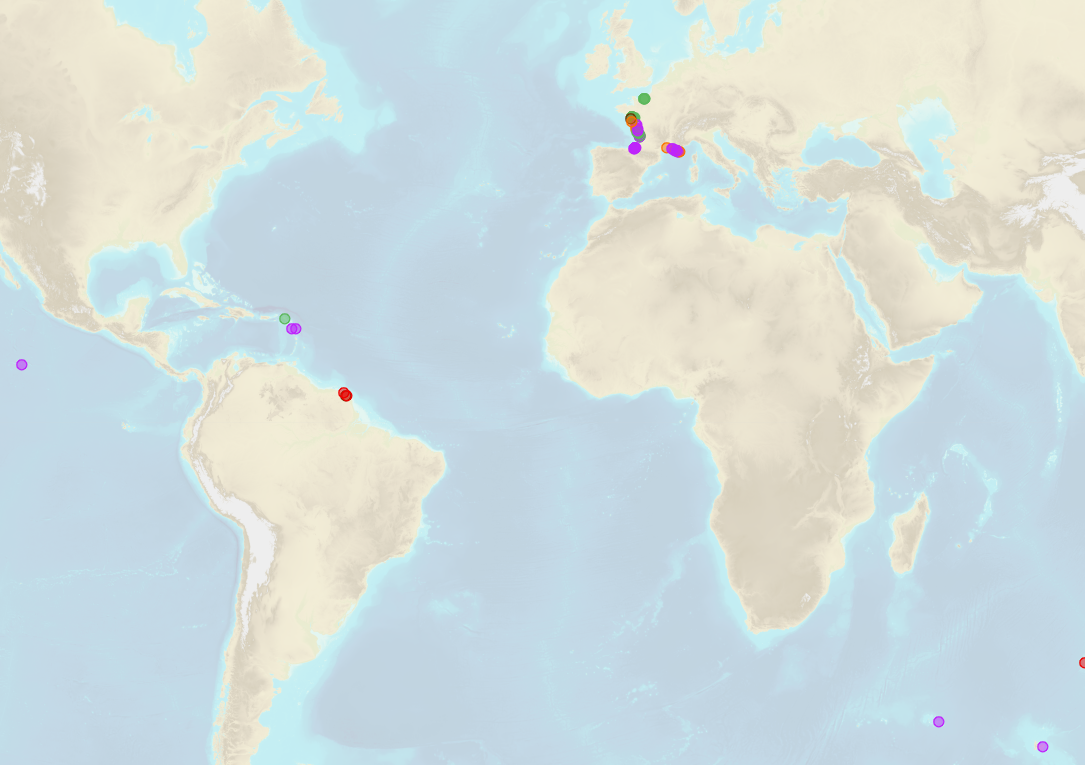
Shom is the national referent for the level of the sea in situ on all areas under French jurisdiction. In this capacity, he assures under the acronym REFMAR different coordination functions in the collection and dissemination of public data related to water level observations, in order to promote their use in multiple applications within the framework of international recommendations.
-
PPRIF
-

Analysis of tuna stomach contents
-

Individuals from five populations of Sabellaria alveolata (Scotland, France-Saint Michel Bay, France-Biarritz, Portugal, and Morocco) were maintained under common garden conditions to investigate the gene expression response to temperature stress in the honeycomb worm. Worms were exposed to five sequential temperature treatments, and whole-organism samples were collected for RNA-Seq analysis. Gene expression patterns were analyzed to assess thermal acclimation and adaptation across populations.
-

Extrait de l'Atlas Aquitaine, Limousin et Poitou-Charentes sur la filière forêt-bois
-
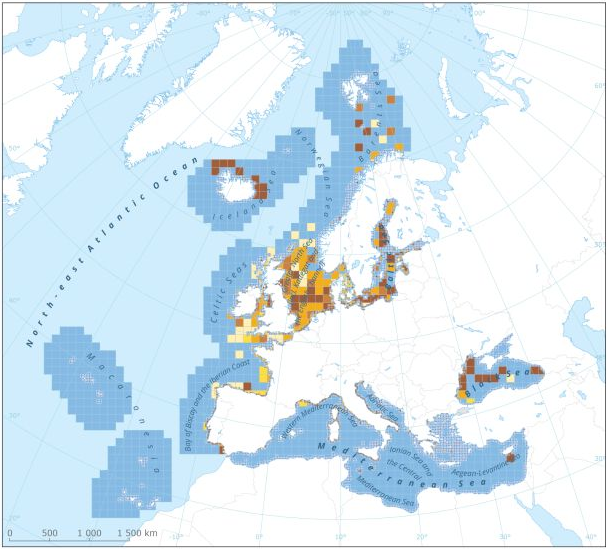
This dataset presents the resulting assessment grid (based on the EEA reference grid) with the classification of chemical status of the transitional, coastal and marine waters in the context of the Water Framework Directive (WFD) and the Marine Strategy Framework Directive (MSFD). This classification has been performed using the CHASE+ tool, with classifications of the matrices ‘water’, ‘sediment’ and ‘biota’ and indicators of ‘biological effects’, as well as an integrated classification of chemical status, combining results of all matrices. The chemical status is evaluated in five classes, where NPAhigh and NPAgood are recognised as ‘non-problem areas’ and PAmoderate, PApoor and PAbad are recognised as ‘problem areas’. This is the assessment made excluding concentrations of mercury (Hg). The overall area of interest used is based on the marine regions and subregions under the Marine Strategy Framework Directive. Additionally, Norwegian (Barent Sea and Norwegian Sea) and Icelandic waters (’Iceland Sea’) have been added (see Surrounding seas of Europe). Note that within the North East Atlantic region only the subregions within EEZ boundaries (~200 nm) have been included. This dataset underpins the findings and cartographic representations published in the report "Contaminants in Europe's Seas" (EEA, 2019).
-
Rapport final ONF
-

Frise chronologique des millésimes de modes d'occupation des sols produits par les régions françaises et par le programme Corine Land Cover.