 Catalogue PIGMA
2026
Type of resources
Available actions
Topics
Keywords
Contact for the resource
Provided by
Years
Formats
Representation types
Update frequencies
status
Service types
Scale
Resolution
-

Plankton was imaged with the PlanktoScope in different oceanic regions using different nets and protocol of conservation. This dataset aims to serve as reference for taxonomic identification with the PlanktoScope across 256 plankton taxa from 20µm to 300µm. Reference dataset can also serve as learning set for prediction in Ecotaxa (https://ecotaxa.obs-vlfr.fr/prj/15535). The full images were processed and segmented with the PlanktoScope around each individual. A set of associated features were measured on the objects with skimage.measure. All objects were classified into 256 different classes using the web application EcoTaxa (http://ecotaxa.obs-vlfr.fr). The following dataset corresponds to the 169, 149 objects and their calculated features. The different files provide information about the features of the objects, their taxonomic identification as well as the raw images. taxa.csv.gz Table of the classification of each object in the dataset, with columns: - object_id: unique object identifier in EcoTaxa. - annotation_category: taxonomic name corresponding to the last level of hierarchy - annotation_hierarchy: taxonomic lineage to the category - set: class of the image corresponding to the taxon - img_file_name: local path of the image corresponding to the taxon, named according to the object id features_native.csv.gz Table of morphological features computed by PlanktoScope. All features are computed on the object only, not the background. All area/length measures are in pixels. - object_id: unique object identifier in Ecotaxa And 33 features: - width: width of the smallest rectangle enclosing the object (pixel) - height: height of the smallest rectangle enclosing the object (pixel) - bx: X coordinates of the top left point of the smallest rectangle enclosing the object (pixel) - by: Y coordinates of the top left point of the smallest rectangle enclosing the object (pixel) - circ.: circularity of the object ((4∗π ∗Area)/Perim^2) [0-1] - area_exc: Surface area of the object excluding holes (pixel2) - area: Surface area of the object (pixel2) - %area: Percentage of object’s surface area that is comprised of holes - major: Length of the primary axis of the best fitting ellipse for the object (pixel) - minor: Length of the secondary axis of the best fitting ellipse for the object (pixel) - y: Y position of the center of gravity of the object (pixel) - x: X position of the center of gravity of the object (pixel) - convex_area: The area of the smallest polygon within which all points in the object fit (pixel2) - perim.: The length of the outside boundary of the object (pixel) - elongation: elongation index (major/minor) - perimareaexc: index of the relative complexity of the perimeter (perim/area_exc) - perimmajor: Index of the relative complexity of the perimeter (perim/major) - circex: Circularity of object excluding white pixels ((4 ∗ π ∗ Area_exc)/perim 2) - angle: Angle between the primary axis and a line parallel to the x-axis of the image - bounding_box_area: Area of the smallest box containing the object (pixel2) - eccentricity: Eccentricity of the ellipse that has the same second-moments as the region. Ratio of the focal distance of the ellipse over the major axis length [0-1] - equivalent_diameter: The diameter of a circle with the same area as the object (pixel) - euler_number: Euler characteristic of the set of non-zero pixels. Computed as number of connected components subtracted by number of holes - extent: Ratio of pixels in the object to pixels in the total bounding box - local_centroid_col: Horizontal coordinate of the center of mass of the object (pixel) - local_centroid_row: Vertical coordinate of the center of mass of the object (pixel) - solidity: Ratio of pixels in the object to pixels of the convex hull image (area / convex_area) - meanhue: Mean base color of the object in hue scale (0-360) - meansaturation: Mean saturation of the object [0-100] - meanvalue: Mean brightness of the object [0-100] - stdhue: Standard deviation of base color - stdsaturation: Standard deviation of saturation - stdvalue: Standard deviation of brightness inventory.tsv Tree view of the taxonomy and number of images in each taxon, displayed as text. With columns : - annotation_hierarchy: taxonomic lineage - annotation_category: name of the taxon - n: number of objects in each taxon group map.png Map of the sampling locations, to give an idea of the diversity sampled in this dataset. imgs Directory containing images of each object, named according to the object id object_id and sorted in subdirectories according to their taxon.
-

EMODnet Chemistry aims to provide access to marine chemistry data sets and derived data products concerning eutrophication, ocean acidification and contaminants. The chemicals chosen EMODnet Chemistry aims to provide access to marine chemistry datasets and derived data products concerning eutrophication, acidity and contaminants. The importance of the selected substances and other parameters relates to the Marine Strategy Framework Directive (MSFD). This aggregated dataset contains all unrestricted EMODnet Chemistry data on potential hazardous substances, despite the fact that some data might not be related to pollution (e.g. collected by deep corer). Temperature, salinity and additional parameters are included when available. It covers the Mediterranean Sea. Data were harmonised and validated by the ‘Hellenic Centre for Marine Research, Hellenic National Oceanographic Data Centre (HCMR/HNODC)’ in Greece. The dataset contains water, sediment and biota profiles and timeseries. The temporal coverage is 1974–2022 for water measurements, 1971–2023 for sediment measurements and 1979-2023 for biota measurements. Regional datasets concerning contaminants are automatically harvested and the resulting collections are harmonised and validated using ODV Software and following a common methodology for all sea regions ( https://doi.org/10.6092/8b52e8d7-dc92-4305-9337-7634a5cae3f4 ). Parameter names are based on P01 vocabulary, which relates to BODC Parameter Usage Vocabulary and is available at: https://vocab.nerc.ac.uk/search_nvs/P01/ . The harmonised dataset can be downloaded as as an ODV spreadsheet, which is composed of a metadata header followed by tab separated values. This spreadsheet can be imported into ODV Software for visualisation (more information can be found at: https://www.seadatanet.org/Software/ODV ). In addition, the same dataset is offered also as a txt file in a long/vertical format, in which each P01 measurement is a record line. Additionally, there are a series of columns that split P01 terms into subcomponents (substance, CAS number, matrix...).This transposed format is more adapted to worksheet applications (e.g. LibreOffice Calc).
-
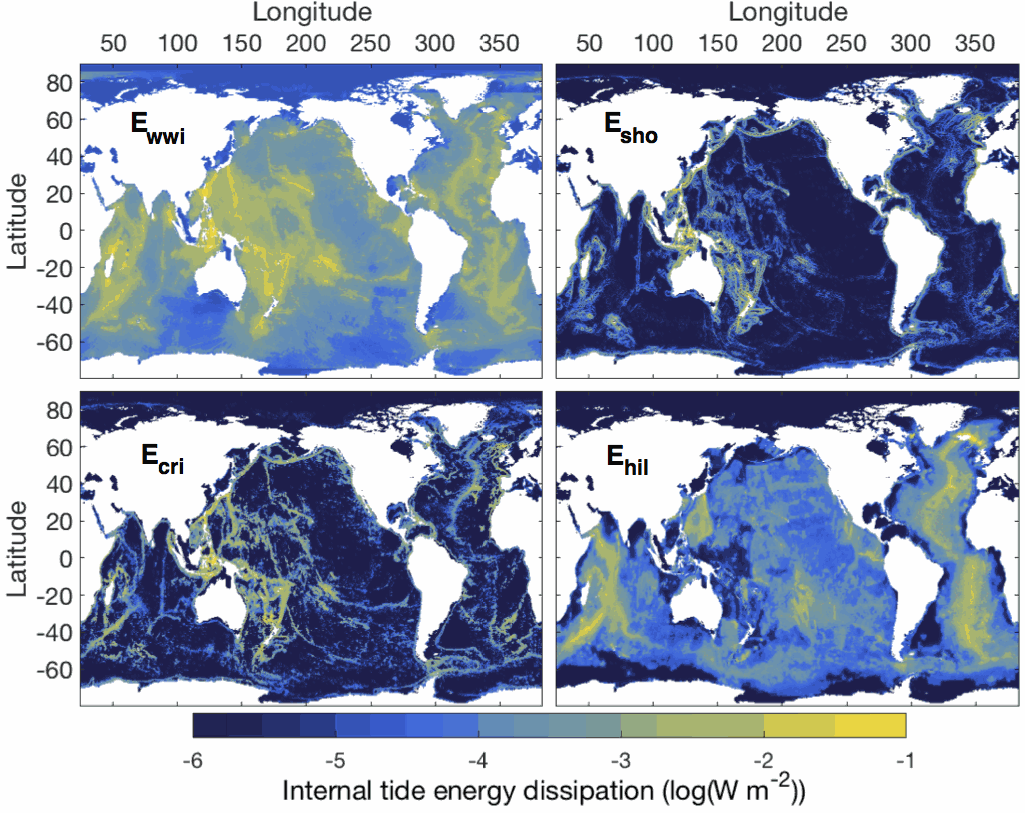
This dataset comprises two netcdf files. The first file contains the six global two-dimensional maps necessary to implement the tidal mixing parameterization presented in de Lavergne et al. (2020). Four power fields (E_wwi, E_sho, E_cri and E_hil) represent depth-integrated internal tide energy dissipation, with units of Watts per square meter. Each power field corresponds to a specific dissipative process and associated vertical structure of turbulence production. The two remaining fields, H_cri and H_bot, are decay heights (with units of meters) that enter the vertical structures of the E_cri and E_hil components, respectively. The second file contains three-dimensional fields of turbulence production (with units of Watts per kilogram) obtained by application of the parameterization to the WOCE global hydrographic climatology. The file includes the total turbulence production (epsilon_tid), its four components (epsilon_wwi, epsilon_sho, epsilon_cri, epsilon_hil), and the underlying hydrographic fields, as a function of longitude, latitude and depth. All maps have a horizontal resolution of 0.5º. Detailed documentation of the parameterization can be found in the following publication: de Lavergne, C., Vic, C., Madec, G., Roquet, F., Waterhouse, A.F., Whalen, C.B., Cuypers, Y., Bouruet-Aubertot, P., Ferron, B., Hibiya, T. A parameterization of local and remote tidal mixing. Journal of Advances in Modeling Earth Systems, 12, e2020MS002065 (2020). https://doi.org/10.1029/2020MS002065
-
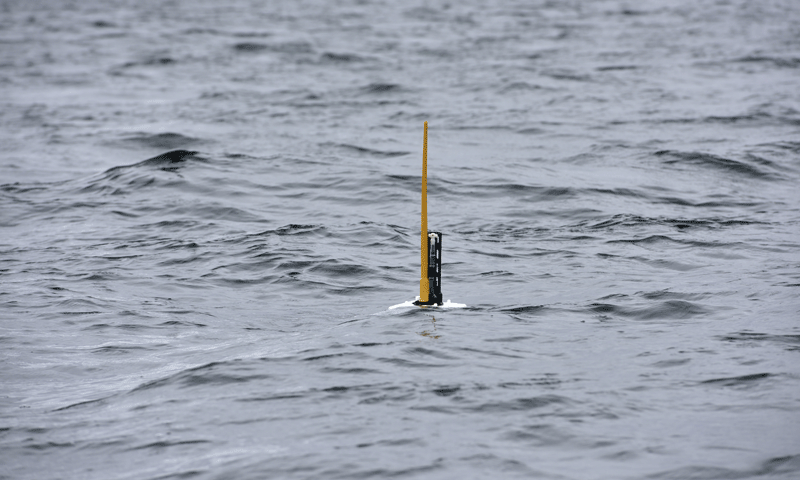
Argo is a global array of 3,000 free-drifting profiling floats that measures the temperature and salinity of the upper 2000 m of the ocean. This allows, for the first time, continuous monitoring of the temperature, salinity, and velocity of the upper ocean, with all data being relayed and made publicly available within hours after collection. The array provides 100,000 temperature/salinity profiles and velocity measurements per year distributed over the global oceans at an average of 3-degree spacing. Some floats provide additional bio-geo parameters such as oxygen or chlorophyll. All data collected by Argo floats are publically available in near real-time via the Global Data Assembly Centers (GDACs) in Brest (France) and Monterey (California) after an automated quality control (QC), and in scientifically quality controlled form, delayed mode data, via the GDACs within six months of collection. The BGC-Argo Sprof snapshot is a subset of the global Argo data snapshot. It is created to ease BGC-Argo data usage. The content is the same if you are to download the global Argo data snapshot, and then select all the BGC-Argo Sprof files. Please use the same DOI and citation as the global Argo data snapshot.
-

The main objective of the SWIM Level 2S (L2S) product is to provide along-track directional wave spectra measures, as well as the integrated parameters of the associated wave systems (wave length, significant wave height, direction), over the global ocean, as observed with SWIM instrument onboard CFOSAT. CFOSAT (Chinese French Ocean SATellite) is a french-chinese mission launched in 2018, whose aim is to provide wind (SCAT instrument) and wave (SWIM instrument) measurements over the sea surface. The wave spectra and their associated partitions are provided independently for each SWIM incidence (from 2° to 10°), together with the sigma0 resampled at a 20m resolution. They are complemented with information from the nadir beam such as the sigma0, wind speed, significant wave height or rain flag. The SWIM level 2S (L2S) product is generated in delayed mode, a few days after acquisition. It complements the Near-Real Time (NRT) L2 product delivered by the CWWIC center by providing an alternative and evolutive processing to test and implement quickly new algorithms for the wave inversion over the whole mission archive. These evolutions may take advantage of better ancillary data not available in NRT (ice mask product, best estimates of wind or wave model), of the combination with wind measurements from the onboard SCAT scatterometer. The product is also designed to handle complex situations such as coastal areas and heterogeneous seas. These complex situations are by nature of particular scientific interest (e.g. wind wave interactions, wave evolution in coastal region). This version 2 improves the previous release in particular through a new empirical modulation transfer function (MTF) and better partitioning. The dataset is also lighter in size. It has been completely reprocessed from SWIM Level 1 archive. Note that the dataset is split on the access server in two different sub-versions (**2.0** for the L2S using Level 1 in OP06 version, **2.1** for the L2S using Level 1 in OP07 version). No major differences are expected. The SWIM L2S product is generated and distributed by Ifremer / CERSAT in the frame of the Ifremer Wind and Wave Operation Center (IWWOC) co-funded by Ifremer and CNES and dedicated to the processing of the delayed mode data of CFOSAT mission.
-

EMODnet Chemistry aims to provide access to marine chemistry datasets and derived data products concerning eutrophication, acidity, contaminants and marine litter. The importance of the selected substances and other parameters relates to the Marine Strategy Framework Directive (MSFD). This aggregated dataset contains all unrestricted EMODnet Chemistry data on floating micro-litter. This dataset is the result of a validation and harmonisation process of the datasets concerning floating micro-litter present in EMODnet Chemistry. The datasets concerning micro-litter are automatically harvested and the resulting collections are harmonised and validated using ODV Software and following a common methodology for all sea regions. Parameter names are based on P01 vocabulary, which relates to BODC Parameter Usage Vocabulary and is available at: https://vocab.nerc.ac.uk/search_nvs/P01/ This process was performed by ‘Istituto Nazionale di Oceanografia e di Geofisica Sperimentale, Division of Oceanography (OGS/NODC)’ from Italy. Harmonisation means that: (1) unit conversion is carried out to express variables with a limited set of measurement units and (2) merging of variables described by different “local names”, but corresponding exactly to the same concepts in BODC P01 vocabulary. The harmonised dataset can be downloaded as ODV collection that can be opened with ODV software for visualization (More information can be found at: https://www.seadatanet.org/Software/ODV ). The same dataset is offered as spreadsheet (txt format, tab separated values) where the values of the categories for the following reported parameters (type, shape, size, color, transparency and material) have been uniformed as labelled in the SeaDataNet H01, H02, H03, H04, H05, H06 vocabularies (https://vocab.seadatanet.org/search ). This format is more adapted to worksheet applications (e.g. LibreOffice Calc).
-
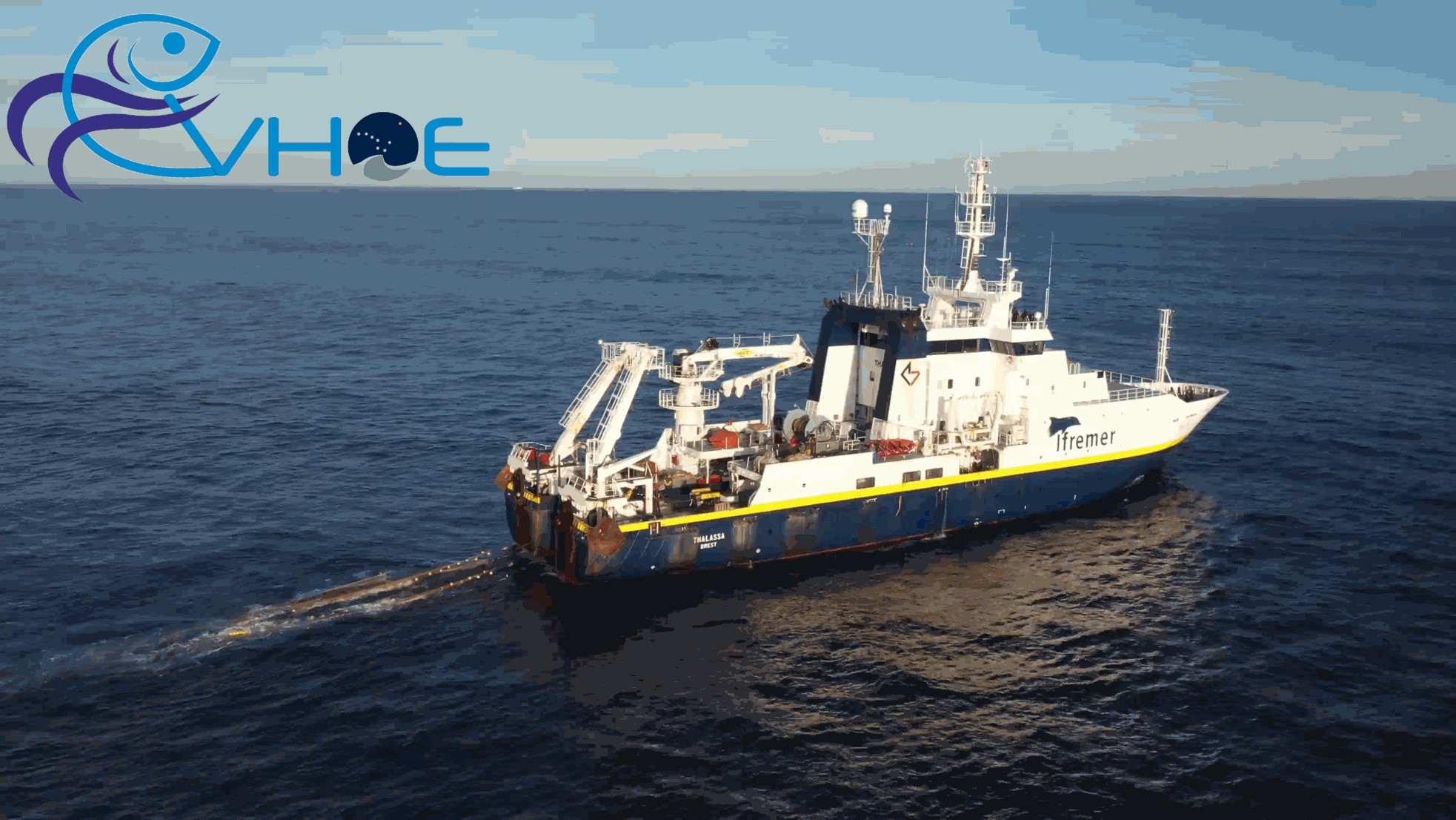
EVHOE (« Evaluation Halieutique de l’Ouest Européen ») surveys provide observational data on bentho-demersal communities on the continental shelves of the Bay of Biscay and the Celtic Sea for more than 30 years. The surveys operate a standardized bottom trawling gear and are conducted from 15 to 600 m depth, usually in the fourth quarter of the year, starting at the end of October. The main objectives are the monitoring of 22 commercial stocks of fish species and 10 cephalopods from the North-East Atlantic. The dataset also provide a description of regional diversity, including 250 taxa of fish, 45 taxa of cephalopods and others “commercial” invertebrates and, from 2008, more than 350 other taxa of benthic invertebrates. The acquisition of this dataset, organised by IFREMER, is steered by the IBTS working group organised within the framework of ICES. It is being funded by the European DCMAP programme, in coordination with the French Directorate-General for Maritime Affairs, Fisheries and Aquaculture (DGAMPA). This dataset is of great interest for the long-term monitoring of the continental shelves of the Bay of Biscay and the Celtic Sea. Moreover, on a larger scale, by being integrated into a European network of bottom trawl surveys, these data play an essential role in studying the evolution of ecosystems from continental shelves to the scale of the eastern North Atlantic. From April 2025, the proposed data have been updated in the latest standard format recognised by IFREMER (‘ELFIC’ format). The 5 data tables are compiled in a .zip file which also contains a document detailing the content of each table and their respective data fields.
-
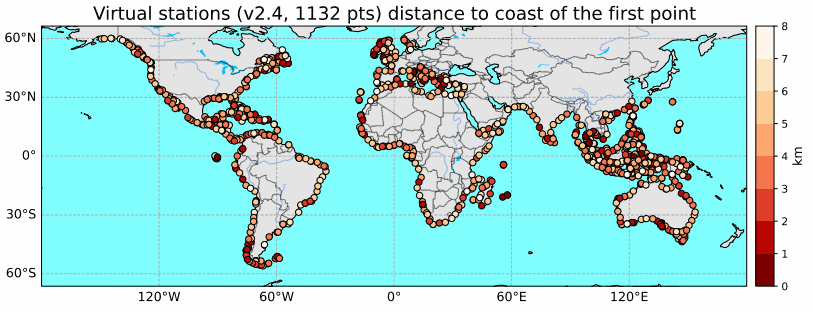
Until recently, classical radar altimetry could not provide reliable sea level data within 10 km to the coast. However dedicated reprocessing of radar waveform together with geophysical corrections adapted for the coastal regions now allows to fill this gap at a large number of coastal sites. In the context of the Climate Change Initiative Sea Level project of the European Space Agency, we have recently performed a complete reprocessing of high resolution (20 Hz, i.e., 350m) along-track altimetry data of the Jason-1, Jason-2 and Jason-3 missions over January 2002 to June 2021 along the coastal zones of Northeast Atlantic, Mediterranean Sea, whole African continent, North Indian Ocean, Southeast Asia, Australia and North and South America. This reprocessing has provided valid sea level data in the 0-20 km band from the coast. More than 1000 altimetry-based virtual coastal stations have been selected and sea level anomalies time series together with associated coastal sea level trends have been computed over the study time span. In the coastal regions devoid from tide gauges (e.g., African coastlines), these virtual stations offer a unique tool for estimating sea level change close to the coast (typically up to 3 km to the coast but in many instances up to 1 km or even closer). Results show that at most of the virtual stations, the rate of sea level rise at the coast is similar to the rate offshore (15 km away from the coast). However, at some stations, the sea level rate in the last 3-4 km to the coast is either faster or slower than offshore.
-
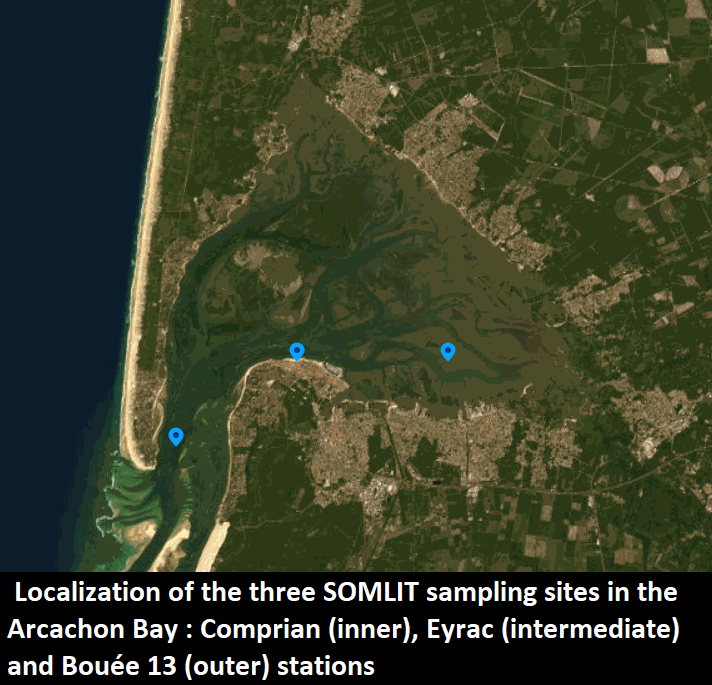
The Arcachon bay is a meso- / macro-tidal (0.8 to 4.6 m), semi-enclosed lagoon of 180 km² located on the South-western coast of France. Three main water masses are described in this bay: (i) the external neritic waters (ENW) directly influenced by the adjacent oceanic waters, (ii) the intermediate neritic waters (ItNW) and (iii) the inner neritic waters (InNW) more influenced by the continental inputs. The watershed of the Arcachon bay, mainly covered by forests, has an area of 3500 km² and the bay is considered as poorly anthropised. It hosts the largest Zostera noltei seagrass meadow in western Europe and is an important site for oyster farming and Manilla clam production. Since 1997, Arcachon Bay waters are monitored for hydrological and bio-geochemical parameters by the “Environnements et Paléoenvironnements Océaniques et Continentaux” (EPOC) Research Unit of the University of Bordeaux-CNRS, first in one single station (Eyrac), then on 2 complementary sites since 2005 (Bouee13 and Comprian). The monitoring is carried out within the national framework of the “SOMLIT” (“Service d’Observation en Milieu Littoral”) which is a French multi-site monitoring network initiated in the mid-1990s. SOMLIT is based on a joint strategy for 19 sites belonging to 12 ecosystems that are distributed over the three maritime facades of mainland France, i.e. the English Channel, the Atlantic Ocean and the Mediterranean Sea. Sampling of surface water samples is performed fortnightly at high tide for a group of 15 parameters (temperature, salinity, dissolved oxygen, pH, nitrate, nitrite, ammonium, phosphate, silicate, suspended matter, chlorophyll a, concentrations and isotopic ratios of particulate organic carbon and nitrogen) and 8 flow cytometry biological variables of pico- and nanoplankton. Vertical profiles of multiparametric probes concerning 4 parameters (temperature, salinity, fluorescence, PAR) are also performed. Given the significant diversity of coastal ecosystems where SOMLIT’s stations are located, strict and joint guidelines with regards to sampling strategy, measurement methods and data qualification and storage are paramount in order to make FAIR data available to users. The whole data acquisition strategy is carried out within the framework of the SOMLIT quality system formalized in 2006-2007 by referring to the ISO 17025: 2017 standard “General requirements for the competence of testing and calibration laboratories”. Unified sampling and analysis protocols are based on recognized disciplinary standards and on the expertise of the research teams. The scientific objectives of SOMLIT are 1) to characterize the multi-decadal evolution of coastal ecosystems; 2) to determine the climatic and anthropogenic forcings and 3) to make data and logistical support available for research activities and other observation activities. SOMLIT is therefore a research tool providing large datasets that also serve as logistical support for related research actions (from seasonal to long-term studies). Two additional national networks operate at the same SOMLIT sites: “COAST-HF” network performs high-frequency measurements (automated in situ measurements every 10 to 20 minutes) and “PHYTOBS-network” provides microphytoplankton biodiversity data. SOMLIT, COAST-HF and PHYTOBS are elementary networks of the Research Infrastructure “Infrastructure Littorale et Côtière” (ILICO) and are National Observation Services (SNO) of the Institut National des Sciences de l'Univers (INSU).
-

The ORHAGO campaigns (Observation of the benthic aquatic resources of the Golfe de Gascogne) are designed to collect data on the composition, distribution and change in relative abundance of benthic fish fauna on the continental shelf (depth <100m) in November to December on a yearly basis. The ORHAGO survey was initiated in 2007 with the objective of developing a fishery-independent abundance index for flatfish species, with a particular focus on the common sole (Solea solea) of the Bay of Biscay. In accordance with the ICES-agreed gear for flatfish abundance surveys, ORHAGO employs a 4-meter-beam trawl with a chain mat, 50-millimeter mesh in the net, and 40-millimeter mesh in the cod-end. The sampling plan was designed to ensure full coverage of the common sole habitat in the Bay of Biscay during a period (November-December) for which fish behavior and distribution was suitable for obtaining an unbiased abundance index (young fish move offshore when coastal waters become colder and before the concentrations of the spawning season). The sampling design is a systematic sampling with 49 reference stations. The sampling design was validated in 2013 by the ICES Working Group on Beam Trawl Surveys (WGBEAM). Since 2013, the ORHAGO survey has been used to assess the status of the Bay of Biscay common sole stock (WGBIE, Working Group for the Bay of Biscay and the Iberian Waters Ecoregion).