Catalogue PIGMA
Pigments
Type of resources
Available actions
Topics
Keywords
Contact for the resource
Provided by
Years
Formats
Representation types
Update frequencies
status
Scale
Resolution
-

This dataset provides a global Look-Up Table (LUT) of physiological ratios for the real-time adjustment of chlorophyll-a fluorescence measured by biogeochemical Argo (BGC-Argo) profiling floats. The physiological ratios aim to account for the global variability in the relationship between fluorescence and chlorophyll-a concentration, as influenced by phytoplankton physiology. The LUT was developed using two different gap-filled observational Argo-based products (SOCA machine learning-based methodology ; Sauzède et al., 2016; Sauzède et al., 2024). The first product provides gap-filled chlorophyll-a data derived from fluorescence corrected for dark signal and non-photochemical quenching (NPQ) following Schmechtig et al. (2023), while the second product provides chlorophyll-a concentrations derived from light attenuation. The latter is based on the downward irradiance at 490 nm (ED490) derived from the SOCA-light method (Renosh et al., 2023). From this, the diffuse attenuation coefficient (KD490) is computed, which is subsequently used to estimate the chlorophyll-a concentration through the bio-optical relationships described by Morel et al. (2007). These two products, based on fluorescence and radiometry, enable the derivation of spatially varying correction factors, or physiological ratios. These ratios provide a validated grounded framework for adjusting real-time fluorescence observations from OneArgo floats into chlorophyll-a concentrations. The LUT is distributed in NetCDF format and is provided on a regular 1°×1° latitude–longitude grid covering the global ocean. Each grid cell contains the temporal mean, averaged over the water column (from the surface to 1.5 times the euphotic depth), of the physiological ratio. The file also includes metadata describing variable definitions, units, and other relevant information. Variables included: - physiological_ratio — fluorescence-to-radiometry-based chlorophyll correction factor (dimensionless) - physiological_ratio_sd — temporal standard deviation (over the twelve months) of the fluorescence-to-radiometry-based chlorophyll correction factor (dimensionless) - lat, lon — spatial coordinates (degrees north/east) - Global attributes — dataset description, reference citation, and contact information
-

This dataset contains the biological outputs of a global ocean simulation coupling dynamics and biogeochemistry at ¼° over the year 2019. The simulation has been performed using the coupled circulation/ecosystem model NEMO/PISCES (https://www.nemo-ocean.eu/), which is here enhanced to perform an ensemble simulation with explicit simulation of modeling uncertainties in the physics and in the biogeochemistry. This dataset is one of the 40 members of the ensemble simulation. This study was part of the Horizon Europe project SEAMLESS (https://seamlessproject.org/Home.html), with the general objective of improving the analysis and forecast of ecosystem indicators. See Popov et al. (https://os.copernicus.org/articles/20/155/2024/) for more details on the study.
-
For the 21 years of the study, an examination of trends in chlorophyll concentration revealed a general decline throughout the Gulf over the production period. These trends, extracted from dynamic linear model, also allowed this decline to be quantified. Expressed as a percentage, a large part of the area below the 50 m bathymetric line showed a decrease of at least 10% over the period, corresponding to a value of at least 0.1 µg.l-1. However, the spatial distribution reveals some more local phenomena. In southern Brittany, from Quimper to Vannes, a particular feature appears, with an upward trend over several kilometres along the coast, followed by a pronounced gradient along the coast. This gradient includes a zone where a continuous monotonic increasing trend is observed, then a zone where the trend becomes not significant and finally, about 15 km from the coast, a new zone where a significant continuous monotonic decreasing trend is observed. The increase in chlorophyll a concentration in the very coastal part is greater than 0.1 µg.l-1 over the period. Another peculiarity concerns the central part, located at the edge of the plateau at Cap Ferrat and Pente Aquitaine, where an increase in chlorophyll a was observed, but the variations remained small, being less than 0.1 µg.l-1. About a hundred kilometres south-west of Saint Nazaire, an area of about 40 by 50 km shows a decrease in chlorophyll a of more than 20%, quantified as more than 0.1 µg.l-1 over the period.
-
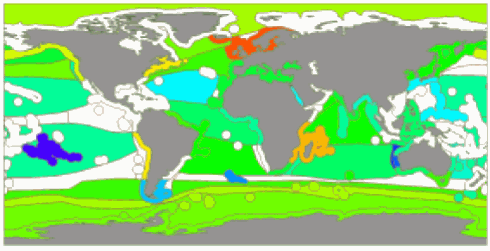
This In Situ delayed mode product integrates the best available version of in situ oxygen, chlorophyll / fluorescence and nutrients data. The latest version of Copernicus delayed-mode BGC (bio-geo-chemical) product is also distributed from Copernicus Marine catalogue.
-
-
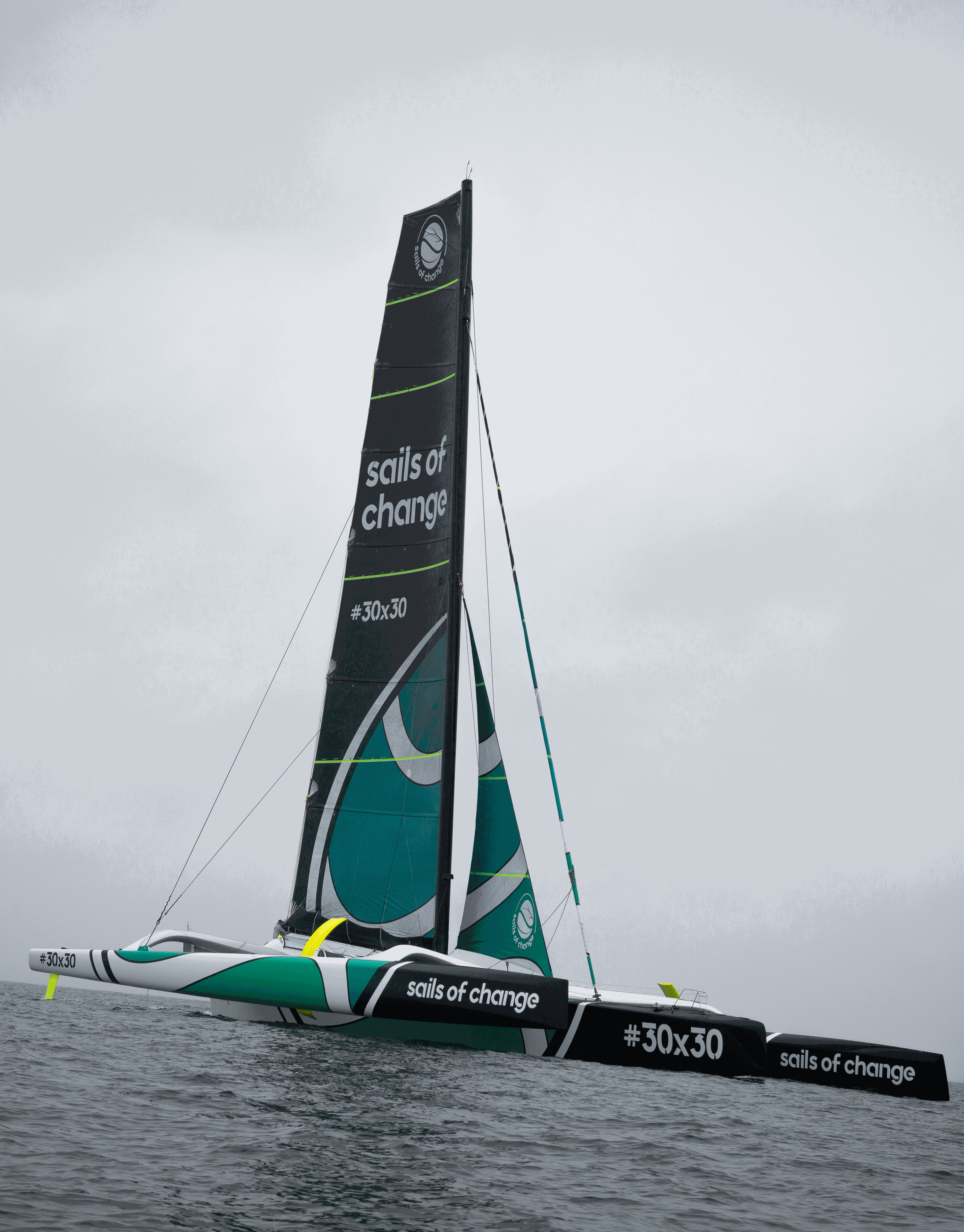
Data collected by the Spindrift 2 Sails of Change vessel during its attempt at the round-the-world sailing record, the Jules Verne Trophy. More information at https://spindrift-racing.com/fr/.
-
-
-
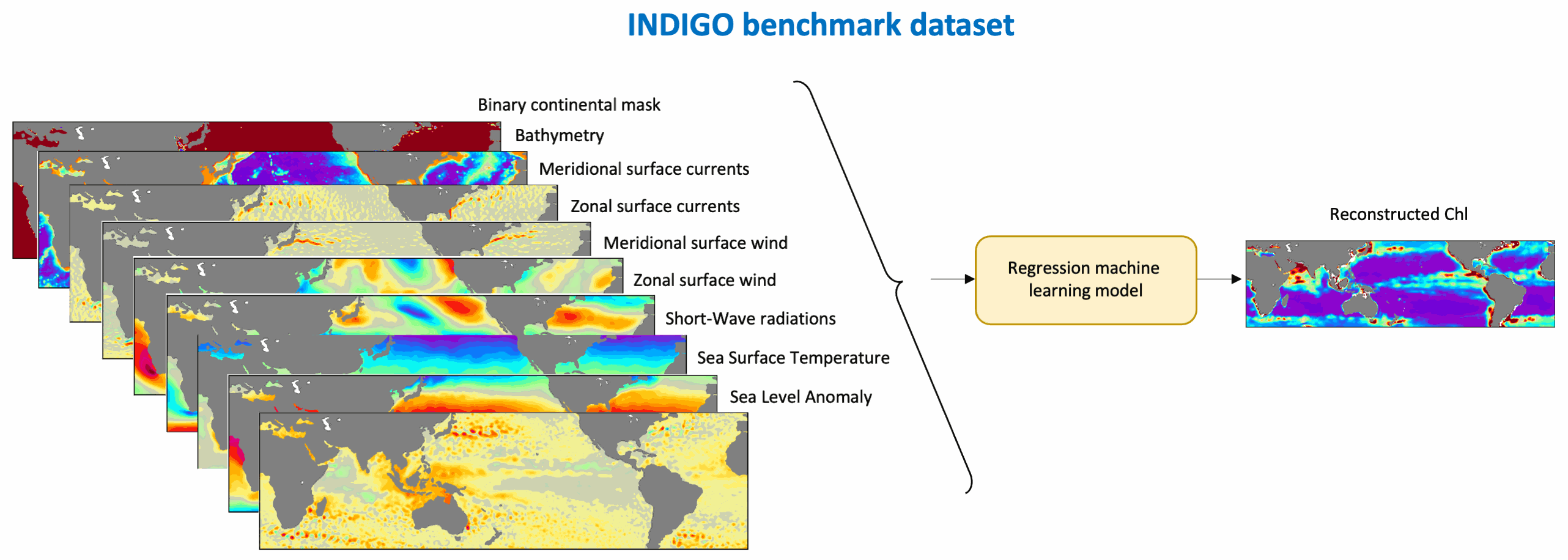
This benchmark dataset contains the physical data used as predictors to reconstruct global chlorophyll-a concentrations (Chl, a proxy of phytoplankton biomass) in Roussillon et al., as well as the reference satellite Chl target fields. The nine physical predictors' data (Short-Wave radiations, Sea Surface Temperature, Sea Level Anomaly, Zonal and meridional surface currents, Zonal and meridional surface wind stress, Bathymetry, Binary continental mask) were extracted from publicly available datasets over [1998-2015] and resampled to the same spatio-temporel resolution as Chl, i.e. monthly on a 1°x1° grid between 50°N and 50°S. Missing values were gap-filled using the heat diffusion equation. Each variable was normalized by substracting its mean from the original values and dividing by its standard deviation over [1998-2015]. This dataset was used to train and validate the Multi-Mode Convolutional Neural network (CNNMM8) introduced in Roussillon et al. ; reconstructed monthly Chl fields over the [2012-2015] test period are also provided here. We hope this benchmark dataset can help to promote the improvements of methods as well as the emergence of new ideas, as building datasets is sometimes more time-consuming than the implementation of machine learning tools themselves. This would also facilitate the quantitative comparison of models performances' on the exact same datasets.
-